
High-Purity & High-Efficiency Ring Roller Mill for Lithium-Ion Battery Anode Materials
Why Do Anode Materials Require a Professional Ring Roller Mill?
The global transition to electric vehicles and renewable energy storage has created unprecedented demand for lithium-ion batteries. Anode material quality is one of the primary determinants of lithium-ion battery performance. The particle size distribution, purity, and surface condition of graphite, petroleum coke, and silicon-carbon composite powders directly affect energy density, charging speed, cycle life, and safety. Getting the grinding step right is not optional. EPIC Powder offers high-purity ring roller mill for lithium-ion battery anode material grinding.
The challenge is that conventional grinding equipment – carbon steel ball mills, standard impact mills – introduces metallic contamination that battery chemistry cannot tolerate. Even a few parts per million of iron, nickel, or chromium can degrade electrode performance and accelerate battery degradation.
EPIC Powder Machinery’s stainless steel ring roller mills are designed specifically for this application. All components in contact with the product are manufactured from 304 or 316L stainless steel. The material-bed grinding principle minimises direct metal-to-metal contact. And the integrated precision classifier delivers the tight particle size distribution that consistent electrode coating requires. This article covers how the technology works, what it delivers, and how it has performed in real production environments.
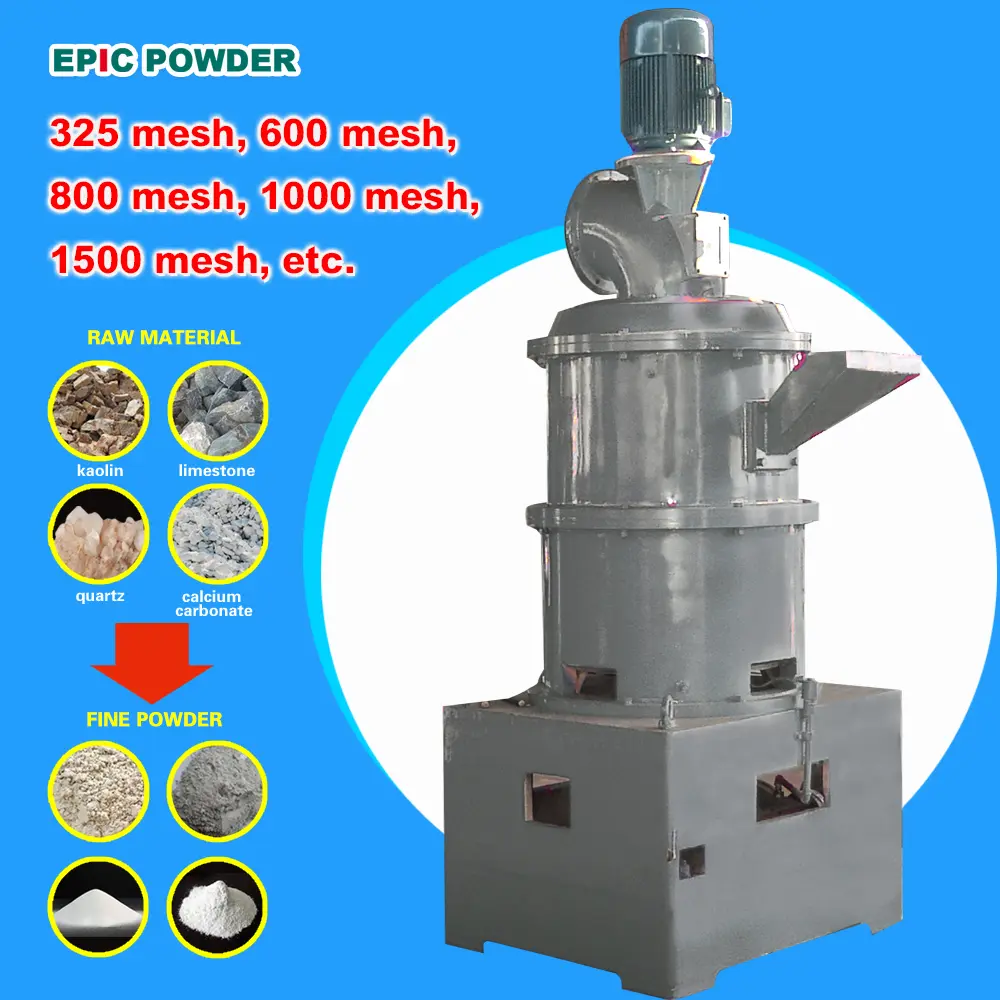
How the Ring Roller Mill Works
The ring roller mill achieves size reduction through a combination of impact, compression, and shear – three forces acting simultaneously on each particle as it passes through the grinding zone. This multi-force approach is more energy-efficient than single-mechanism mills and produces a tighter particle size distribution.
The Grinding Mechanism
Material fed into the mill falls between the uppermost layer of grinding rollers and the fixed grinding ring. As the roller assembly rotates, material is drawn into the precision gap between roller and ring, where impact, compression, and shear work together to reduce particle size. The material then cascades downward through multiple successive layers of rollers and rings, being ground at each stage. By the time it reaches the bottom of the grinding zone, it has passed through four or more progressive grinding stages.
A key design feature is the material-bed principle: particles grind primarily against each other, not against the metal surfaces. A thin layer of crushed material always sits between the roller and the ring, acting as a cushion and as the primary grinding medium. This dramatically reduces metal wear and, for battery applications, means metallic contamination from roller and ring wear is kept below 5-10 ppm.
Classification and Closed-Loop Control
Ground material falls to the collection tray at the base of the mill and is carried upward by an airflow stream to the integrated classifier wheel at the top. The classifier wheel spins at a controlled speed. Particles that meet the target size pass through the wheel and exit to the dust collection system as finished product. Oversized particles are centrifuged back to the grinding zone for further reduction.
This closed-loop design means no oversized particles reach the product. D97 is a hard cutoff, not a statistical average. And because classifier wheel speed is adjustable, you can change your target fineness – D50, D97, and span – without stopping the mill or making mechanical changes.
| Ring Roller Mill Process Flow Feed: Jaw crusher reduces feed to <10-20 mm, then bucket elevator to storage hopper Grinding: 4+ layer roller-ring grinding (impact + compression + shear in series) Classification: Integrated dynamic classifier – adjustable D50 and D97 Collection: Pulse bag filter, 99.9% efficiency, discharge valve to product bin Air circuit: Closed loop, negative pressure – clean, dust-free operation |
Key Advantages for Battery Anode Material Production
1. High Purity – Stainless Steel Throughout
Every component that contacts your material – grinding rollers, grinding rings, fan blades, pipework, classifier wheel, and housing – is manufactured from 304 or 316L stainless steel. There is no carbon steel or cast iron anywhere in the product contact path.
Combined with the material-bed grinding principle, this construction consistently achieves iron content increases below 5-10 ppm across the full production run. For battery manufacturers supplying top-tier cell producers, this level of purity control is a supply qualification requirement, not a nice-to-have.
For the most demanding applications – silicon-based anode materials, pharmaceutical-grade requirements, or chemically aggressive precursors – 316L stainless steel with its superior corrosion resistance and lower trace metal release is the recommended choice. For standard graphite and petroleum coke processing, 304 stainless steel delivers equivalent contamination control at lower equipment cost.
2. Precise Particle Size Control – 325 to 2500 Mesh in One Pass
The EPIC Powder stainless steel ring roller mill produces finished powder from 325 mesh (D97 45 microns) to 2500 mesh (D97 5 microns) in a single pass. The classifier wheel speed determines the cut point. Increasing wheel speed produces finer product; decreasing it produces coarser product. No screen changes, no mechanical adjustments.
| Target Fineness | Typical Output (SRM1250) | Energy Comparison vs Ball Mill | Common Application |
| D97 45 microns (325 mesh) | 10-12 t/h | ~30% lower | Standard conductive additive, anode blends |
| D50 15-20 microns | 8-10 t/h | ~30% lower | High-performance graphite anode |
| D50 10-12 microns | 6-8 t/h | ~35% lower | Premium anode, fast-charging batteries |
| D97 5-8 microns | 3-5 t/h | ~40% lower | Ultra-fine specialty, silicon-carbon composites |
Output figures are for graphite processing on SRM1250. Actual performance varies with feed material characteristics and target fineness. Contact EPIC Powder for figures specific to your material.
3. Lower Energy Consumption Than Ball Mills and Jet Mills
For the same material and target fineness, the ring roller mill achieves over 30% lower specific energy consumption than a ball mill. Compared to jet milling – which is widely used for battery materials but has very high compressed air energy costs – the ring roller mill offers substantially lower operating cost per tonne for the D50 10-45 micron range.
Jet milling remains the correct choice for the finest particle sizes (D50 below 5 microns) and for applications where zero metallic contact is required even at trace levels. But for the majority of graphite and petroleum coke applications in the D50 5-20 micron range, the ring roller mill delivers equivalent purity at significantly lower operating cost.
4. Clean, Dust-Free Operation
The entire system operates under negative pressure. Dust cannot escape the circuit into the work environment. The integrated pulse bag filter achieves 99.9% collection efficiency, ensuring maximum product recovery and compliance with environmental and workplace safety requirements.
5. Simple Installation, Low Civil Works
Unlike ball mills, which require heavy reinforced foundations and multi-storey steel structures, the ring roller mill arrives as integrated modular units that require only a flat concrete pad. Most installations are complete and producing specification material within 5-7 days of equipment delivery. This translates directly to lower capital investment and faster time to first production.
Applicable Anode Materials
The EPIC Powder stainless steel ring roller mill is suitable for all major lithium-ion battery anode material types and precursors:
| Material | Typical Feed / Product Specification | Role in Anode Production |
| Natural graphite (flake, amorphous) | Feed <10 mm, D97 target 10-25 microns | Primary active material |
| Artificial graphite | Feed <10 mm, D97 target 10-20 microns | High-performance anode active material |
| Petroleum coke (calcined) | Feed <20 mm, D97 target 10-15 microns | Graphitised anode precursor |
| Needle coke | Feed <10 mm, D97 target 8-15 microns | Ultra-high power density anode |
| Pitch coke / coal tar pitch coke | Feed <10 mm, D97 target 10-20 microns | Cost-effective anode blend component |
| MCMB (mesocarbon microbeads) | Fine feed, D97 target 5-15 microns | Specialty high-rate batteries |
| Spheronisation tailings | Coarse fraction from spheroniser | Recovered as conductive additive or anode blend |
| Silicon-carbon composites (SiO2) | Fine feed, D97 target 3-10 microns | Next-generation high-capacity anode |
Case Study
| Spheronisation Tailing Recovery for a European Natural Graphite ProcessorThe challenge A European specialty graphite processor was generating large quantities of coarse tailings from their spheronisation process – material that represented nearly 30% of their input feed. This was being sold at low value or disposed of as waste. The company needed to convert it into D97 below 20 micron fine powder suitable for sale as a battery conductive additive. The solution On-site trials confirmed the SRM800 stainless steel ring roller mill as the right fit, with a specially configured classifier wheel optimised for the flow characteristics of spheronised graphite tailings. Results Output: 1.5-2.0 tonnes per hour of D97 18 micron product Energy consumption: 40% lower than their previous jet mill trials for the same target fineness Product purity: no measurable increase in metal content Payback period: equipment investment recovered within 14 months from increased product revenue and reduced waste disposal cost |
Model Range and Technical Specifications
(SRM1250 and SRM1680 are currently out of stock. We are now offering only the SRM800 and SRM1000 models.)
| Specification | SRM800 | SRM1000 | SRM1250 | SRM1680 |
| Feed size (mm) | <10-20 | <10-20 | <10-20 | <10-20 |
| Feed moisture (%) | <5 | <5 | <5 | <5 |
| Mill motor (kW) | 75 | 132 | 185 | 315 |
| Classifier motor (kW) | 15-18.5 | 22-30 | 37-60 | 55-92.5 |
| Fan motor (kW) | 37-45 | 55-75 | 75-110 | 132-180 |
| Product fineness (mesh) | 325-2500 | 325-2500 | 325-2000 | 325-1500 |
| Capacity range (t/h) | 0.5-4.0 | 1.0-8.0 | 2.0-12 | 3.0-20 |
Capacity depends on material characteristics, target fineness, and feed moisture. Contact EPIC Powder for material-specific performance projections.
| 304 vs 316L Stainless Steel: Which Grade Do You Need? 304 stainless – recommended for: natural graphite, artificial graphite, petroleum coke, needle coke, pitch coke. Standard choice for most anode materials. 316L stainless – recommended for: silicon-based materials, materials with higher acidity or chloride content, pharmaceutical-grade requirements, or any application where the absolute lowest trace metal release is specified. Cost difference: 316L carries a moderate premium over 304 due to its molybdenum content. For most carbon-based anode materials, 304 delivers equivalent contamination performance at lower equipment cost. |
| Discuss Your Anode Material Grinding Requirements with EPIC Powder Machinery Whether you are processing petroleum coke, natural graphite, artificial graphite, or silicon-carbon composites, the right mill configuration – stainless steel grade, classifier speed, airflow balance, feed size – determines product purity, throughput, and operating cost. Our engineering team helps you get those parameters right from the start.We offer free material testing at our facility and can provide guaranteed performance data before you commit to a purchase. Lab-scale trials are available for all EPIC Powder stainless steel ring roller mill models. Request a Free Material Trial: www.rollermill.net/contact Explore Our Stainless Steel Ring Roller Mill Range: www.rollermill.net |
Conclusion
The lithium-ion battery industry demands excellence at every step of the production chain. For anode material manufacturers, choosing the right grinding equipment is not just about particle size—it’s about purity, consistency, efficiency, and reliability.
EPIC Powder’s Stainless Steel Ring Roller Mill offers:
- Uncompromising purity with stainless steel construction and material-bed grinding
- Precise fineness control from 325 to 2500 mesh in a single pass
- Superior energy efficiency reducing operating costs by over 30%
- Proven reliability with 20+ years of industry experience
- Rapid installation getting you into production faster
Whether you are processing natural graphite, artificial graphite, petroleum coke, or emerging silicon-carbon composites, we have the expertise and equipment to optimize your production.
Fill out the form below or contact us via WhatsApp. Our experts will respond within 6 hours to discuss your needs and schedule confidential consultations. Let EPIC Powder help you produce the high-purity anode materials that power the world’s clean energy future.
With over 20 years of experience in ultra-fine powder processing, EPIC Powder is your trusted partner for advanced grinding solutions.

“Thanks for reading. I hope my article helps. Please leave a comment down below.
You may also contact EPIC Powder online customer representative Zelda for any further inquiries.”
— Emily Chen, Engineer

