Bamboo Powder as a Biodegradable Plastic Filler
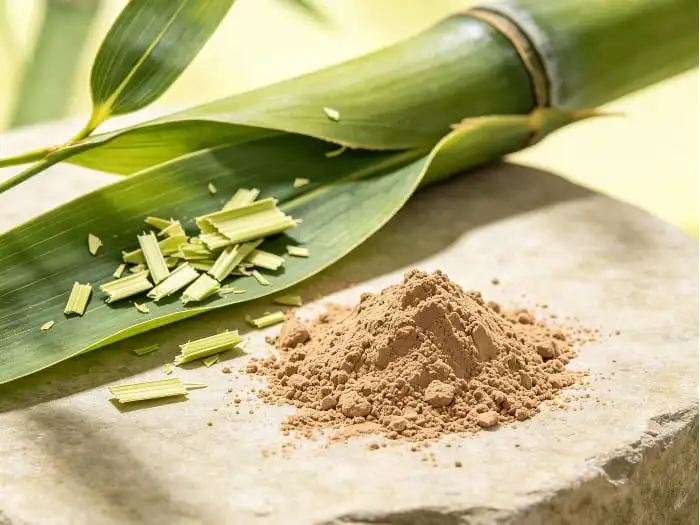
Bamboo powder is produced from bamboo processing waste — approximately 30% of bamboo processing output can be recovered as usable powder. It is a bio-based filler for biodegradable plastics that serves as an alternative to calcium carbonate and starch. It can be used in films, bags, injection-moulded items, and agricultural mulch films. Unlike calcium carbonate, it contributes bio-based carbon content to the finished product. It matters for products claiming biodegradable or bio-based certifications. Unlike starch, it does not significantly compromise mechanical strength at high filler loadings.
Bamboo powder’s main components are cellulose (approximately 37% in 3-year-old moso bamboo), lignin (approximately 24.5%), and hemicellulose, with small amounts of ash, protein, and pectin. These proportions vary by species, age, and processing method. The cellulose fraction is responsible for bamboo powder’s reinforcing properties and its high aspect-ratio fibre morphology. The lignin fraction contributes thermal resistance and structural integrity.
The practical performance of bamboo powder as a filler depends almost entirely on particle size. The same raw bamboo material, processed to four different fineness levels, produces four functionally different filler grades suited to four different applications. The processing route — which combination of ring-roller mill, air classifier, and jet mill is used — determines which grade is produced.
The Four Bamboo Powder Grades and Their Processing Routes
Bamboo powder for plastics applications is classified by D90 into four grades. Each grade requires a different processing configuration and serves different downstream markets.
| Grade | D90 Range | Tap Density | Processing Route | Primary Applications |
| Coarse | mm scale | > 0.40 g/cm3 | Rough planing, wire drawing only | Cat litter, animal feed, cement mortar, bakelite |
| Fine | 30-60 um | ~0.33 g/cm3 | Ring-roller mill | Injection-moulded cutlery, coffee cups, seedling trays |
| Micro | 10-30 um | ~0.26 g/cm3 | Ring-roller mill + air classifier | Biodegradable shopping bags, express bags, trash bags |
| Ultra-fine | < 10 um (D90) | ~0.17 g/cm3 | Ring-roller mill + classifier + jet mill + classifier | Biodegradable agricultural mulch film |
The tap density column is particularly significant for logistics and cost reasons. As particle size decreases from fine to ultra-fine grade, tap density drops from 0.33 to 0.17 g/cm3 — a halving of packing density. This affects bulk bag weight, storage volume, and conveying behaviour. Ultra-fine bamboo powder at 0.17 g/cm3 is extremely light and prone to dusting. This affects handling equipment selection and dust management requirements at the compounding facility.
Bamboo Powder’s Key Characteristics as a Polymer Filler
Particle Morphology: Fibrous and High Aspect Ratio
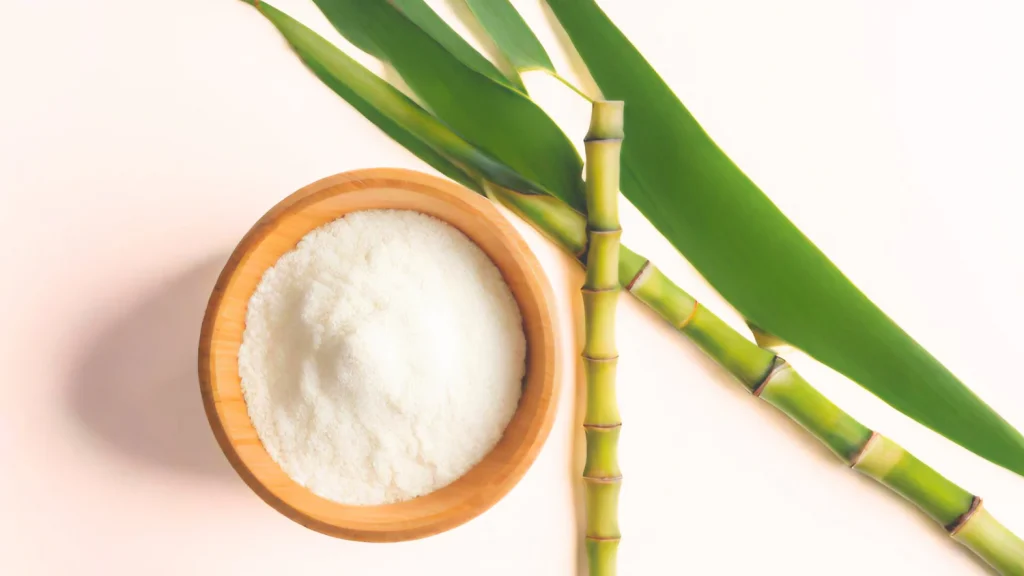
Bamboo powder particles are not equiaxed like calcium carbonate — they retain an elongated fibre shape from the bamboo’s cellular structure. Average particle length is approximately 0.61 mm at coarse grades, with widths averaging 136 microns. As grinding progresses to finer grades, this aspect ratio is progressively reduced as fibres are broken across their length. At micro grade (D90 10-30 microns), individual particles are still elongated relative to spherical fillers. At ultra-fine grade (D90 below 10 microns), surface energy dominates and the material begins to exhibit characteristics more like a high-surface-area filler than a fibrous reinforcement.
The high aspect ratio of coarser bamboo powder grades is both an advantage and a challenge. High aspect ratio particles can act as reinforcing fibres in a polymer matrix, transmitting stress from the matrix into the fibre and improving tensile properties. But they also increase melt viscosity during processing and can create anisotropic shrinkage during moulding. This is why fine bamboo powder (D90 30-60 microns) is used in injection moulding applications rather than film extrusion. The fibre aspect ratio is acceptable in a thick-section moulded part but would cause film tearing during blow moulding.
Hydrophilicity: The Core Compatibility Problem
Bamboo powder contains abundant hydroxyl groups from its cellulose and hemicellulose components. These polar groups are strongly hydrophilic. Most polymer matrices used for biodegradable films — PBAT, PLA, PBS — are hydrophobic. The fundamental incompatibility between a hydrophilic filler and a hydrophobic matrix is the primary technical limitation of bamboo powder as a polymer filler.
Without surface modification, bamboo powder particles do not bond effectively to the polymer matrix. Instead, they act as stress concentration points that reduce elongation at break and tensile strength. Surface modification with coupling agents (silane, titanate) or esterification reduces the hydroxyl group density on the bamboo particle surface and creates covalent or strong physical bonds with the polymer matrix. For high-fill-ratio products (bamboo loading above 30% by weight), surface modification is essentially mandatory for acceptable mechanical properties.
Thermal Stability: The Processing Temperature Constraint
The initial decomposition temperature of bamboo powder is approximately 200-250 degrees C, with maximum decomposition rate at 300-350 degrees C. The processing temperatures of common biodegradable polymers are: PBAT extrusion at 160-190 degrees C, PLA at 170-200 degrees C, PBS at 150-180 degrees C. Bamboo powder processing is therefore possible without significant degradation at standard biodegradable polymer processing temperatures. However, higher processing temperatures (above 200 degrees C) risk accelerated colour change and partial decomposition, particularly for fine bamboo powder with high surface area. Screw design, mixing intensity, and residence time in the extruder all need to be managed to avoid thermal degradation.
Processing Routes by Grade
Fine Grade (D90 30-60 μm): Ring-Roller Mill Only
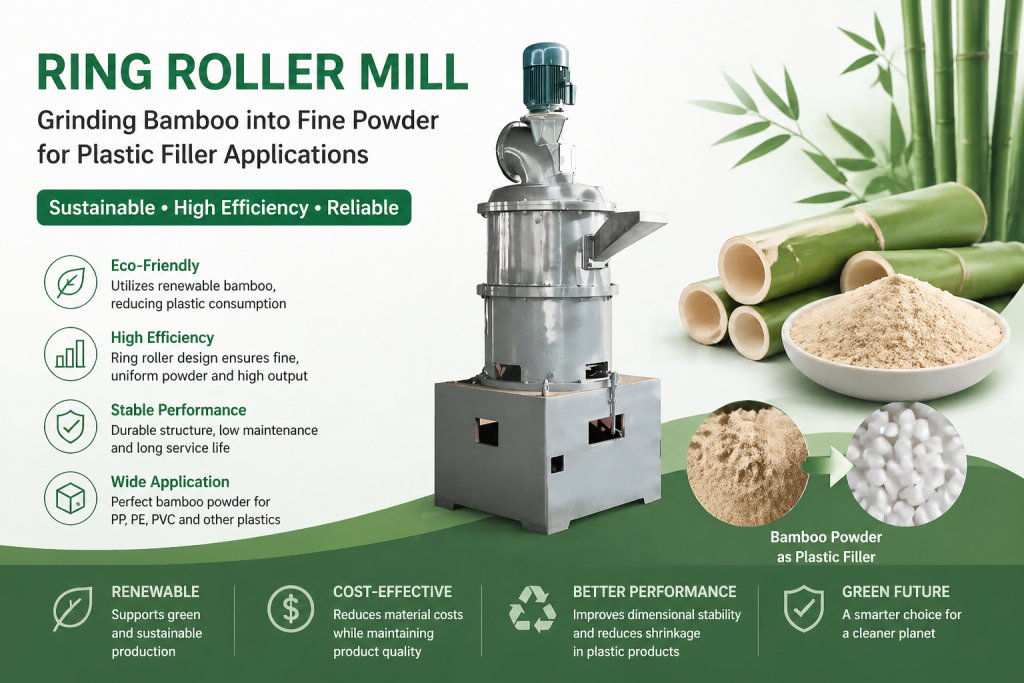
Fine bamboo powder is produced by feeding bamboo residues (bamboo shavings, off-cuts, waste from strip processing) into a ring-roller mill. The ring-roller mill’s multi-layer compression-shear grinding reduces the bamboo fibres progressively from millimetre scale to the 30-60 micron range. The integrated VFD-controlled air classifier sets the D90 upper limit; oversize material returns to the grinding zone. A single ring-roller mill pass from appropriately sized bamboo feed material can produce D90 30-60 microns at production throughputs of 1-5 t/h depending on the mill model.
At this grade, bamboo powder has sufficient particle size reduction to mix well with biodegradable polymer in twin-screw compounding, but the elongated fibre structure is partially preserved. It is suitable for injection-moulded single-use items — cutlery, cups, plates — where wall thickness is sufficient to accommodate some fibre aspect ratio without film-formation problems.
Micro Grade (D90 10-30 μm): Ring-Roller Mill + Air Classifier
Producing micro bamboo powder requires a two-stage process: the ring-roller mill produces a primary ground product in the 30-80 micron range, and a downstream air classifier sharpens the cut to the D90 10-30 micron target. The classifier removes oversize particles (above 30 microns D90) back to the ring-roller mill feed and discharges on-spec product to collection. The circulating load in this configuration is typically 150-300% — for every tonne of product produced, 1.5-3 tonnes of material is circulating through the mill and classifier at any moment.
At D90 10-30 microns, bamboo powder transitions from a fibre reinforcement to a surface-active filler. The specific surface area increases substantially compared to the coarse grade, which improves polymer-filler interfacial contact area and, with appropriate surface modification, improves tensile properties relative to unfilled polymer. This grade is the standard for biodegradable film and bag applications, where the particle size is small enough to pass through film extrusion die lips without causing die lines or film rupture.
Ultra-Fine Grade (D90 < 10 μm): Four-Stage Process
Ultra-fine bamboo powder below D90 10 microns cannot be produced economically in a single ring-roller mill pass. The four-stage process is: ring-roller mill (primary size reduction to approximately 30-60 microns) → air classifier (sharp cut at approximately 20-30 microns, coarse fraction returns to mill) → fluidised bed jet mill (secondary size reduction of the classified product to below 10 microns D90) → air classifier (final sharp cut at D90 target, removes any remaining coarse fraction).
The jet mill stage is necessary because ring-roller mills become progressively less efficient below approximately D90 15-20 microns for fibrous materials like bamboo powder. At fine sizes, bamboo fibres are pliable rather than brittle. They bend rather than break under the compression-shear forces of the ring-roller mechanism. Jet milling uses particle-on-particle collision at high velocity. It overcomes the fibre flexibility and achieves the fracture needed for sub-10-micron grinding. The air classification stage after the jet mill removes the coarse tail that always exists in jet mill output and provides the hard D90 upper cut required for film applications.
| Processing Route Selection by Target Grade Fine grade (D90 30-60 um): Ring-roller mill with integrated VFD air classifier — single stage, 1-5 t/h throughput Micro grade (D90 10-30 um): Ring-roller mill + standalone air classifier in closed circuit — two stages, 0.5-2 t/h product Ultra-fine grade (D90 < 10 um): Ring-roller mill → classifier → jet mill → classifier — four stages, 0.2-0.8 t/h product Surface modification (all grades): Optional dry surface modification unit immediately downstream of final classifier; integrated into the production line without a separate step |
Performance Comparison: Bamboo Powder vs Calcium Carbonate and Starch
Bamboo powder for biodegradable plastics is commercially positioned as an alternative to calcium carbonate and starch fillers. An honest assessment shows where it has genuine advantages and where it does not yet perform equivalently.
- Bio-based content: bamboo powder’s strongest advantage. It is a bio-based material that contributes to the product’s bio-based carbon content by certification standards. Calcium carbonate is inorganic — it contributes zero bio-based carbon. Starch is bio-based but functionally different.
- Density reduction: bamboo powder’s tap density of 0.17-0.33 g/cm3 is substantially lower than calcium carbonate at 0.8-1.2 g/cm3. Products with high bamboo powder loading are measurably lighter than equivalent CaCO3-filled products — relevant for bags and films sold by area rather than weight.
- Mechanical properties in film applications: currently, bamboo powder-filled PBAT films do not outperform CaCO3-filled or starch-filled films in tensile strength or elongation at break at equivalent filler loading. This is the primary area where surface modification and ultra-fine grinding are expected to close the gap as processing technology improves.
- Processing compatibility: bamboo powder at high loading levels requires more careful screw design and temperature management than CaCO3, which is thermally stable at all polymer processing temperatures. Bamboo powder’s 200-250 degrees C initial decomposition temperature means processing margins are tighter.
The honest summary is that bamboo powder-filled films already meet national standards for biodegradable agricultural film, shopping bags, and logistics packaging in China. They are commercially viable. But they are not yet superior to CaCO3-filled alternatives in mechanical performance — they compete on bio-based content, density, and sustainability narrative rather than raw mechanical performance metrics.
EPIC Powder Machinery Equipment for Bamboo Powder Processing
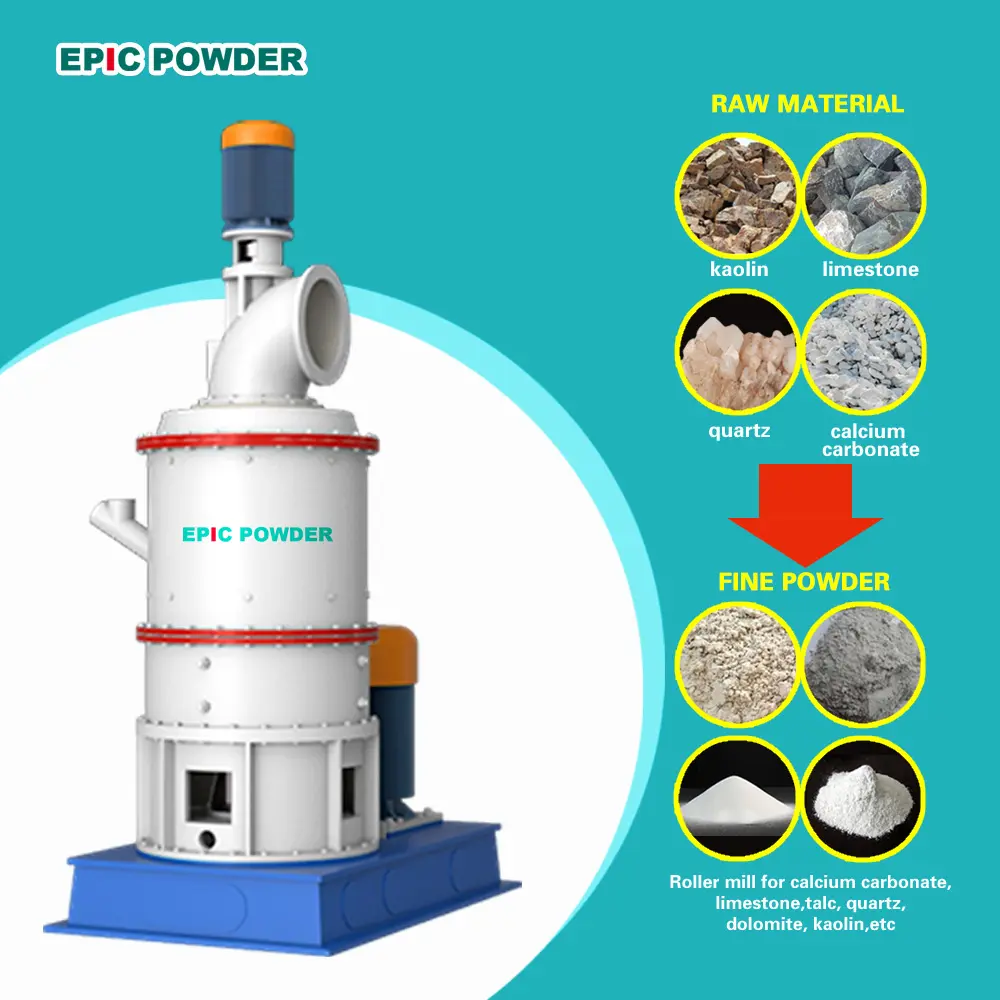
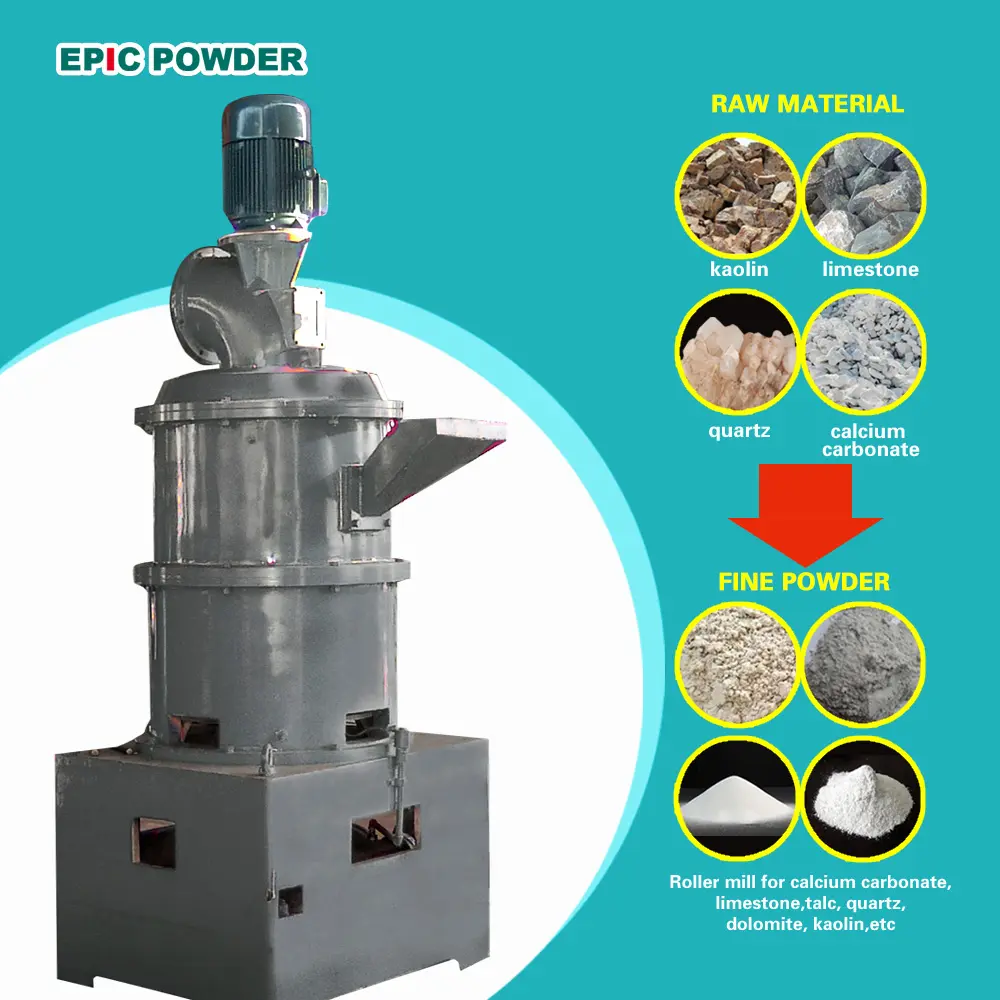
EPIC Powder Machinery‘s SRM series ring-roller mills and air classifier systems are the core equipment for fine and micro bamboo powder production. The SRM series covers D90 from 60 microns down to approximately 15 microns in a single stage with integrated VFD air classifier. The classifier sets the D90 upper cut and returns oversize to the grinding zone. For micro grade production at D90 10-30 microns, a standalone classifier downstream of the SRM provides the sharper cut and higher classification efficiency needed for the finer target.
For ultra-fine bamboo powder at D90 below 10 microns, EPIC Powder supplies the complete four-stage line: SRM ring-roller mill → first-stage air classifier → fluidised bed jet mill → second-stage air classifier. The jet mill stage handles the transition from ring-roller mill product (D90 approximately 20-30 microns) to ultra-fine product (D90 below 10 microns). So the ring-roller mill’s compression-shear mechanism is no longer the most effective grinding method for bamboo’s fibrous structure.
| Designing a Bamboo Powder Grinding Line for Biodegradable Plastics? EPIC Powder Machinery designs and supplies complete bamboo powder grinding and classification lines — ring-roller mill, air classifier, and jet mill configurations for any target D90 from 60 microns down to below 10 microns. We offer free material trials: send us your bamboo material and target grade and we will return PSD data, tap density measurements, and a recommended equipment configuration with projected throughput.Tell us your starting bamboo material (moso, phyllostachys, or other), target D90, and whether you need the full four-stage ultra-fine route or a simpler two-stage process. Request a Free Process Design Consultation: rollermill.net/contact Explore Our Ring-Roller Mill and Classifier Systems: rollermill.net |
Frequently Asked Questions
Why does bamboo powder need a four-stage process to reach D90 below 10 microns, while calcium carbonate can be ground to the same fineness in two stages?
The difference is fibre flexibility versus brittleness. Calcium carbonate (Mohs hardness 3) is a brittle mineral. It fractures cleanly under compression and shear forces. At any particle size, it breaks when sufficient stress is applied. Bamboo powder contains cellulose fibres that are viscoelastic at processing conditions: when a ring-roller mill applies compression to a bamboo particle below approximately 15-20 microns D90, the particle bends and deforms rather than fracturing.
The ring-roller mill’s compression-shear mechanism becomes increasingly ineffective at fine sizes for fibrous materials. A fluidised bed jet mill overcomes this through velocity: particles collide at high speed (200-400 m/s) in convergent gas jets, and the short duration of the impact applies stress faster than the fibre can viscoelastically deform. This brittle-versus-fibrous difference is why mineral fillers can reach fine D90 values in a simpler processing circuit than bamboo powder, and why the jet mill stage is necessary for ultra-fine bamboo powder production.
Can the same ring-roller mill be used to produce both fine grade (D90 30-60 μm) and micro grade (D90 10-30 μm) bamboo powder?
Yes, with a documented grade-change procedure. The SRM ring-roller mill’s product D90 is controlled by the integrated VFD air classifier wheel speed. If increasing wheel speed, it moves the cut point finer, while decreasing it moves it coarser. Switching between fine grade (D90 40-50 microns) and micro grade (D90 15-25 microns) requires increasing the classifier wheel speed to the micro grade recipe setting, allowing the circuit to reach steady state at the new circulating load (approximately 20-40 minutes), confirming D90 by sampling, and releasing product to the micro grade stream.
For micro grade, the higher circulating load means the mill is processing more returned oversize material per tonne of product. Throughput drops compared to fine grade production from the same mill. If your production requires both grades in high volume, sizing the mill for the micro grade throughput target and derating it for fine grade production (higher throughput, lower circulating load) is the standard approach. The standalone air classifier in the micro grade circuit can also be bypassed when producing fine grade from the same mill, simplifying the circuit.
Epic Powder
Epic Powder, 20+ years of experience in the ultrafine powder industry. Actively promote the future development of ultra-fine powder, focusing on crushing, grinding, classifying and modification process of ultra-fine powder. Contact us for a free consultation and customized solutions! Our expert team is dedicated to providing high-quality products and services to maximize the value of your powder processing.

“Thanks for reading. I hope my article helps. Please leave a comment down below.
You may also contact EPIC Powder online customer representative Zelda for any further inquiries.”
— Emily Chen, Engineer