The Complete Guide to Types of Roller Mill: Fine Powder vs. Coarse Powder Solutions
Choosing the right roller mill is critical for powder processing efficiency, product quality, and operational cost. Whether you need ultra-fine powders in the range of 200 to 1250 mesh or coarse sands and granules from 10 to 100 mesh, understanding the different types of roller mills allows you to match equipment performance to your exact material and output goals. From ring roller mills and vertical roller mills to Raymond mills, double roll crushers, and double roll grinders, each design serves a distinct purpose. In this guide, we break down every major type with real cases and answers to frequently asked questions.
At Epic Powder, we help clients across mining, chemical, building materials, and food industries select and optimize the right milling equipment. In this guide, we break down each roller mill type with real-world cases and answers to frequently asked questions.
Fine Powder Roller Mills
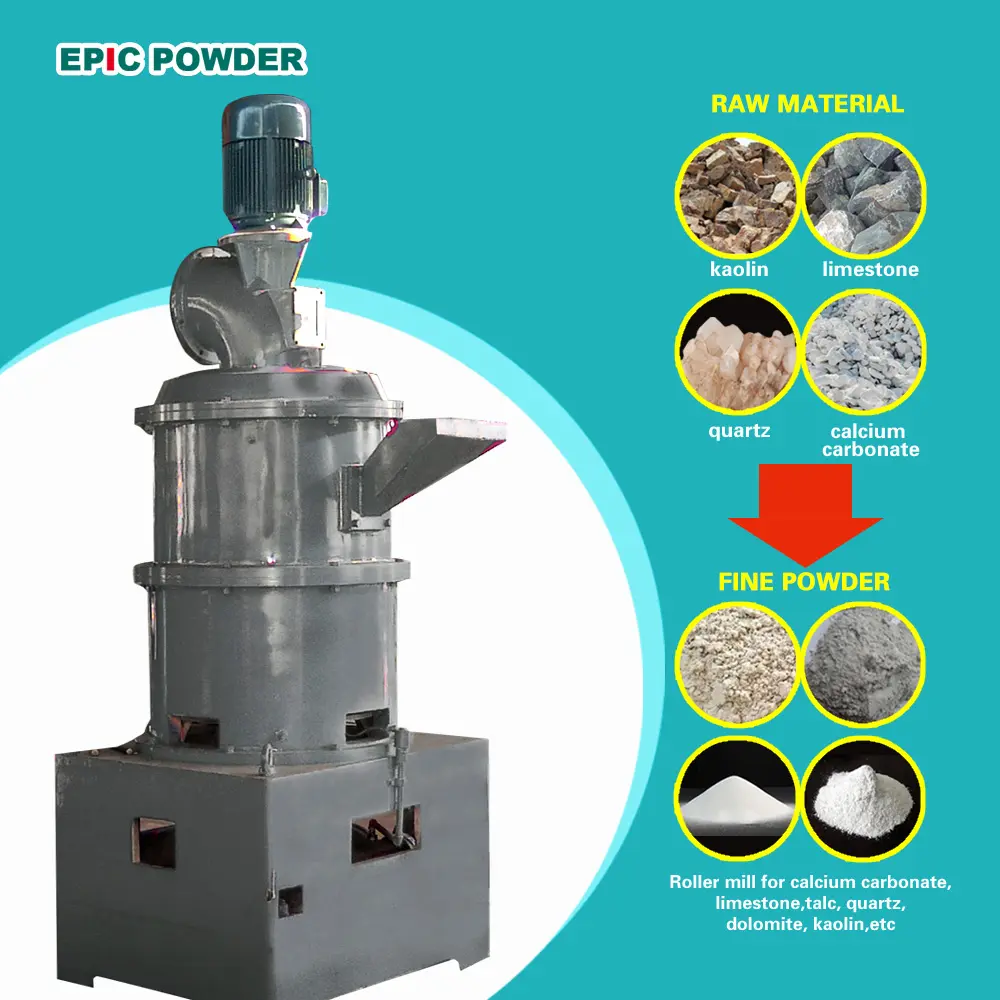
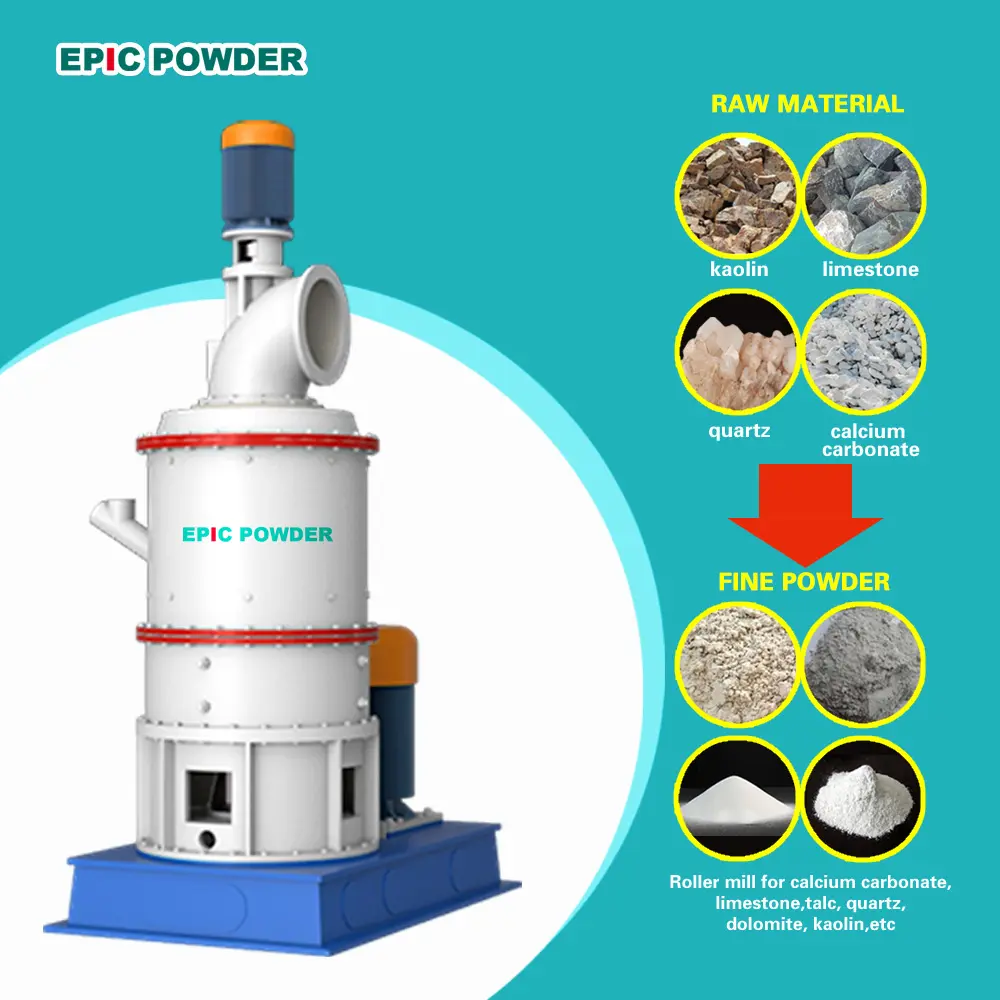
When your target is fine to ultra-fine powder, such as calcium carbonate, talc, gypsum, barite, or bentonite, three roller mill designs dominate the market.
1. Ring Roller Mill
How it works: Material is fed between a rotating grinding ring and multiple spring-loaded rollers. The centrifugal force pushes rollers outward against the ring, crushing and shearing material into fine powder. Airflow carries fines to a classifier, while oversize particles fall back for regrinding.
Best for:
- Non-metallic minerals like calcite, limestone, and dolomite
- Achieving 325 to 2500 mesh (5 to 45 microns)
- Materials with low to medium hardness, typically Mohs below 5
Case Study – Calcium carbonate plant in Guangxi, China
A client processing ground calcium carbonate switched from a ball mill to an Epic Powder ring roller mill. The results were impressive: output increased from 3 tons per hour to 5.5 tons per hour at 1250 mesh, energy consumption dropped by 28 percent, and product whiteness improved by 3 percent due to reduced iron contamination.
Key advantage: The ring roller mill offers a compact footprint, low noise levels, and the ability to produce both fine and ultra-fine powder in a single pass.
2. Table Roller Mill / Vertical Roller Mill
How it works: Material falls onto a rotating grinding table and passes under hydraulically loaded rollers. The table’s rotation throws ground material outward to an integrated air classifier, and oversized particles are returned to the table for further grinding.
Best for:
- Large-scale production, typically 5 to over 100 tons per hour
- Cement raw meal, slag, coal, and calcite
- Achieving 200 to 400 mesh, with optional ultra-fine classification available
Case Study – Cement plant in Vietnam
A 500,000 ton per year cement plant replaced an old ball mill with an Epic Powder vertical roller mill for slag grinding. The new system achieved power consumption of just 32 kWh per ton, compared to 48 kWh per ton in the ball mill. It also combined drying, grinding, and classifying in one unit, eliminating the need for a separate dryer, and reduced maintenance downtime by 60 percent.
Key advantage: The vertical roller mill delivers the highest throughput, integrated drying capability, and the lowest operating cost per ton for large volumes.
3. Raymond Roller Mill / Pendulum Roller Mill
How it works: This classic pendulum design uses rollers that swing outward under centrifugal force to grind material against a stationary grinding ring. A fan recirculates air to carry fines to a cyclone or baghouse.
Best for:
- Small to medium capacity, typically 1 to 10 tons per hour
- Materials such as barite, limestone, gypsum, clay, and activated carbon
- Achieving 80 to 400 mesh (180 to 38 microns)
Case Study – Gypsum powder plant in Thailand
A plasterboard manufacturer needed 200 mesh gypsum powder at 4 tons per hour. The Epic Powder Raymond roller mill delivered stable operation with 95 percent passing 200 mesh. The mill also allowed quick roller changes, taking only 4 hours compared to 12 hours on competitor mills, and required a lower initial investment than a vertical mill.
Key advantage: The Raymond roller mill features a simple structure, easy maintenance, and very reliable performance for common industrial minerals.
Coarse Powder and Sand Roller Mills for 10 to 100 Mesh
For applications requiring granules, chips, or coarse sand, such as glass sand, quartz, fertilizer, coal, or foundry sand, roller crushers and grinders are the right choice.
4. Double Roll Crusher
How it works: Two counter-rotating smooth or toothed rollers crush material by compression. One roller is fixed, while the other moves to adjust the gap and protect against uncrushable objects.
Best for:
- Hard to medium-hard materials up to Mohs hardness 7
- Reducing feed size from as large as 100 mm down to 5 to 20 mm granules
- Applications involving coal, coke, glass, limestone, and metal ores
Case Study – Glass recycling plant in Malaysia
A glass bottle recycler needed to crush post-consumer glass into 6 to 10 mm cullet for remelting. An Epic Powder double roll crusher with toothed rollers achieved an output of 15 tons per hour at a 6 mm gap setting. The system produced less than 3 percent fines below 0.5 mm, which is critical for furnace melting efficiency. Tungsten carbide wear plates extended roller life by three times.
Key advantage: The double roll crusher generates low dust, offers an adjustable gap, and features robust construction for abrasive materials.
5. Double Roll Grinder
How it works: This machine is similar to a crusher but operates with a narrower gap of 1 to 5 mm and higher roller speed or differential speed to create shearing action. The roller surface may have corrugations or be smooth with micro-grooves.
Best for:
- Producing coarse powder in the 10 to 80 mesh range from soft to medium materials
- Materials such as salt, sugar, fertilizer, clay, graphite, and carbon black
- Friable materials that should not be over-ground into dust
Case Study – Potash fertilizer plant in Canada
A potash producer needed 20 to 40 mesh granules for direct application. An Epic Powder double roll grinder with stainless steel rollers and spring loading delivered 12 tons per hour of product with 90 percent between 20 and 40 mesh. The system produced uniform particle shape with no sharp edges, unlike hammer mills, and kept dust emissions below 15 mg per cubic meter with an integrated enclosure.
Key advantage: The double roll grinder provides precise particle size distribution, minimal over-grinding, and excellent performance for heat-sensitive or friable materials.
Quick Comparison: Fine vs. Coarse Roller Mills
| Parameter | Ring / Vertical / Raymond Mills | Double Roll Crusher | Double Roll Grinder |
|---|---|---|---|
| Output size | Ring roller mill: 325–2000 mesh (45–7 microns) Vertical / Raymond mill: 200–400 mesh typical | 5–20 mm (coarse granules) | 10–80 mesh (coarse powder) |
| Feed size max | Less than 30 mm | Less than 100 mm | Less than 50 mm |
| Typical hardness | Mohs below 5 | Mohs up to 7 | Mohs below 5 |
| Moisture tolerance | Below 6 percent (drying optional) | Below 15 percent | Below 10 percent |
| Main industry | Mineral powder, cement, chemical | Glass, coal, aggregates | Fertilizer, salt, carbon |
Case Study: Epic Powder Client in Indonesia
Challenge:
A mineral processing company wanted to produce two products from separate lines to avoid contamination. They needed 5 tons per hour of 600 mesh talc powder for the fine line, and 8 tons per hour of 20 to 40 mesh quartz sand for the coarse line.
Solution from Epic Powder:
For the fine line, we recommended a ring roller mill from the MRR series with an integral classifier. For the coarse line, we supplied a double roll grinder from the PRG series with smooth rollers and an adjustable gap.
Results after six months:
The fine talc line achieved 98 percent passing 600 mesh with energy consumption of 38 kWh per ton. The coarse quartz line delivered 92 percent of product between 20 and 40 mesh with zero over-grinding fines. The total return on investment was achieved in 11 months, driven by reduced maintenance and consistent product quality.
Frequently Asked Questions (FAQ)
Q1: Can one roller mill produce both fine powder and coarse sand?
No, fine mills such as ring, vertical, and Raymond mills rely on airflow and classifiers to produce sub-100 mesh powder. Coarse mills like double roll crushers and grinders use mechanical compression and shearing. Using a fine mill for coarse product wastes energy, while using a coarse mill for fine powder will not achieve the required mesh. Epic Powder always recommends separate lines or a two-stage system that starts with a crusher and then a fine mill.
Q2: Which roller mill is best for calcium carbonate?
For 200 to 400 mesh, a Raymond roller mill is economical. For 600 to 1250 mesh, a ring roller mill gives higher yield and lower power consumption per ton. For capacities above 50 tons per hour, a vertical roller mill is the best choice. Epic Powder can run your material in our laboratory to confirm the optimal solution.
Q3: How do I prevent metal contamination from roller mills?
You can use ceramic or tungsten carbide rollers and liners. Epic Powder offers ceramic coated grinding rings and rollers for ring mills, as well as carbide faced rollers for double roll mills. These options are ideal for white minerals or food and pharmaceutical applications.
Q4: What is the maintenance difference between these roller mills?
For a Raymond mill, rollers and rings wear fastest, typically every 300 to 500 hours for hard materials, but they are cheap and easy to replace. A ring roller mill offers longer wear life of 800 to 1200 hours, though disassembly is more complex. A vertical mill uses hydraulic roller pressure and requires skilled maintenance, but it has fewer parts. Double roll mills require only roller replacement, and gap adjustment is simple. Epic Powder provides wear parts kits and remote troubleshooting for all mill types.
Q5: Can I use a double roll crusher for soft material like limestone?
Yes, but you may generate too many fines. For limestone above 10 mesh, a double roll grinder with smooth rollers and lower speed is a better choice. For limestone powder below 100 mesh, you must use a fine roller mill rather than any type of crusher.
Let Epic Powder Match Your Application
No single roller mill works for every powder or granule size. The wrong choice leads to high energy bills, frequent downtime, or off-spec product.
Ready to optimize your powder processing? Visit our roller mill page or contact our engineering team for a free recommendation based on your target mesh, capacity, and material hardness.
Choosing the right roller mill is critical for powder processing efficiency, product quality, and operational cost. Whether you need ultra-fine powders in the range of 200 to 1250 mesh or coarse sands and granules from 10 to 100 mesh, understanding the different types of roller mills allows you to match equipment performance to your exact material and output goals. From ring roller mills and vertical roller mills to Raymond roller mills, double roll crushers, and double roll grinders, each design serves a distinct purpose. In this guide, we break down every major type with real-world cases and answers to frequently asked questions.
Epic Powder
At Epic Powder, we offer a wide range of equipment models and tailor solutions to meet your specific needs. Our team has more than 20 years experience in various powders processing. Epic Powder is specialized in fine powder processing technology for mineral industry, chemical industry, food industry, pharama industry, etc.
Contact us today for a free consultation and customized solutions!

“Thanks for reading. I hope my article helps. Please leave a comment down below. You may also contact EPIC Powder online customer representative Zelda for any further inquiries.”
— Jason Wang, Engineer