Ring Roller Mill vs Raymond Mill: Which One Is Right for Your Mineral Processing?
When it comes to grinding non‑metallic minerals, two names frequently come up: the Raymond mill and the Ring roller mill. Both are vertical roller mills that share a similar outward appearance, yet they are fundamentally different in design, performance, and end‑product capabilities. If you are in the market for a grinding solution, understanding the differences between these two technologies is critical. This guide provides a clear comparison to help you make an informed decision.
What Is a Raymond Mill?
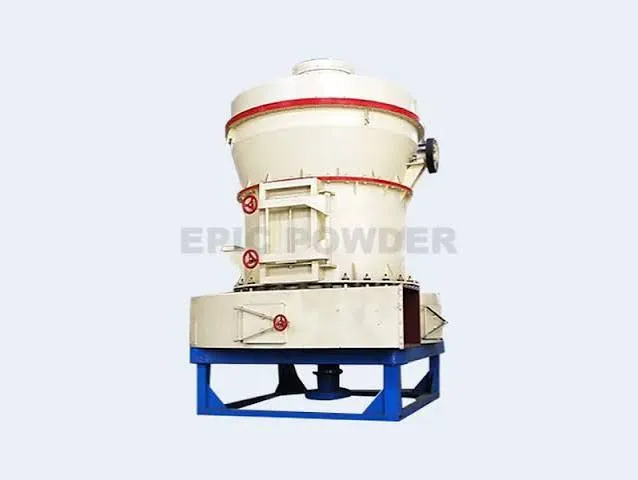
The Raymond mill has been an industry standard for over a century. It is an air‑swept vertical ring‑roll mill with an integrated classification system that simultaneously dries, pulverises, and classifies materials.
How It Works
In a Raymond mill, the grinding rollers are suspended on a pendulum‑style assembly. As the main shaft rotates, centrifugal force causes the rollers to swing outward and press tightly against the stationary grinding ring. Material is fed between the rollers and the ring, where it is crushed and ground. A blower then carries the ground particles upward to the classifier, where fines are collected and oversized particles are returned for regrinding.
The number of grinding rollers in a Raymond mill typically ranges from 3 to 6, arranged in a spring plum blossom frame assembly.
Typical Applications
Raymond mills are widely used for grinding non‑metallic minerals with a Mohs hardness below 7, including:
- Limestone
- Gypsum
- Barite
- Talc
- Kaolin
- Phosphate rock
- Coal
- Petroleum coke
What Is a Ring Roller Mill?
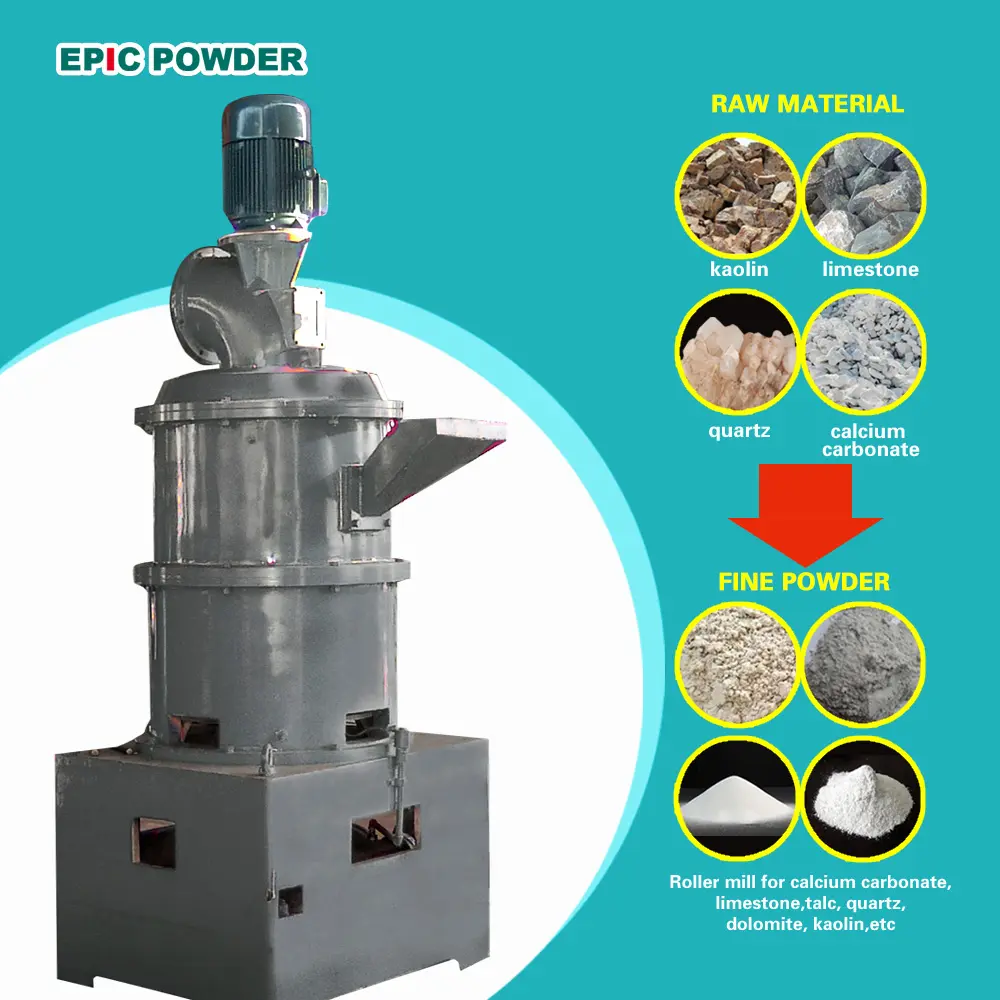
The ring roller mill is a more recent generation of grinding equipment that builds upon the principles of the Raymond mill while overcoming many of its limitations. It is designed for high‑efficiency, energy‑saving dry ultra‑fine grinding.
How It Works
In a ring roller mill, multiple layers of grinding rollers rotate around the main shaft. Under the combined action of high‑pressure springs and centrifugal force, the rollers swing outward horizontally and press tightly against the grinding ring. A key difference is the high‑pressure spring system: under the same power input, the grinding roller pressure of a ring roller mill is approximately twice that of a Raymond mill (a figure supported by many equipment manufacturers’ published data).
The mill operates on comprehensive mechanical grinding principles—rolling, grinding, and impact working together to achieve superior size reduction.
Typical Applications
Ring roller mills are suitable for processing a wide range of non‑metallic minerals, including:
- Calcium carbonate
- Barite
- Talc
- Gypsum
- Limestone
- Calcite
- Dolomite
- Bentonite
- Feldspar
Head‑to‑Head Comparison
1. Working Principle
| Feature | Raymond Mill | Ring Roller Mill |
|---|---|---|
| Roller configuration | 3–6 pendulum‑style hanging rollers | Multiple layers of rollers (up to 36) |
| Grinding force | Centrifugal force only | Centrifugal force + high‑pressure springs |
| Roller pressure | Baseline | ~2× higher than Raymond mill |
| Grinding mechanism | Compression | Rolling + grinding + impact |
The higher grinding force of the ring roller mill translates directly into better performance on harder materials and finer particle sizes.
2. Product Fineness Range
This is where the ring roller mill truly distinguishes itself.
Raymond Mill:
- Standard fineness range: 80–425 mesh (315–45 μm)
- With modifications, some models can reach up to 600 mesh
- The finest achievable is approximately 1000 mesh (0.013 mm) for a small fraction of the product
Ring Roller Mill:
- Fineness range: 325–2500 mesh (45–5 μm)
- Final fineness can reach D97 ≤ 3 μm
- Capable of producing from coarse powder to superfine powder in a single pass
Verdict: If your application requires powders finer than 400 mesh, the Raymond mill simply cannot deliver. The ring roller mill is the clear winner for ultra‑fine powder production.
3. Energy Consumption
Energy efficiency is a major consideration for any grinding operation, as power costs typically represent a significant portion of operating expenses.
Raymond Mill:
- Moderate energy consumption (compression‑based grinding)
- Lower energy consumption than ball mills (over 60% less)
Ring Roller Mill:
- Low energy consumption—currently considered one of the most energy‑efficient fine grinding equipment options available
- Under the same fineness conditions, ring roller mills achieve about 30% lower energy consumption compared to ball mills, jet mills, and stirred mills (a figure widely cited in industry literature)
- Production efficiency is significantly higher than that of Raymond mills under the same power conditions—some sources indicate more than double the throughput
Verdict: The ring roller mill offers substantial energy savings—typically 30% or more—while delivering finer products and higher throughput.
4. Investment and Operating Costs
| Cost Factor | Raymond Mill | Ring Roller Mill |
|---|---|---|
| Initial investment | Lower capital cost | Moderate—higher than Raymond, lower than jet mills |
| Installation | Requires some civil work | Minimal civil engineering required; often no large‑scale foundation work |
| Maintenance cost | Moderate—rollers and rings require regular replacement | Generally lower—wear parts (rollers, rings, scrapers) are made of durable materials and are designed for extended service life |
| Operating cost | Low | Very low—energy savings and reduced maintenance compound over time |
Key insight: While the initial purchase price of a ring roller mill may be higher than a Raymond mill, the total cost of ownership (TCO) over the equipment’s lifetime is often significantly lower due to energy savings, reduced maintenance, and higher productivity.
5. Applicable Materials
| Material Characteristic | Raymond Mill | Ring Roller Mill |
|---|---|---|
| Maximum hardness | Mohs < 7 | Can handle harder materials than Raymond mills; some models are capable of processing materials up to Mohs 9.2 (depending on the specific mill design) |
| Maximum moisture | < 6% | < 5% (for most models) |
| Feed size | ≤ 20 mm | ≤ 10 mm |
The ring roller mill’s ability to handle harder minerals makes it suitable for a broader range of applications, including varieties that would cause excessive wear on a Raymond mill.
6. Maintenance and Reliability
Raymond Mill:
- Maintenance difficulty: Medium
- Rollers and rings require regular replacement
- Lubrication system requires periodic attention
Ring Roller Mill:
- Maintenance difficulty: Low
- Wear parts (rollers, rings, scrapers) are made of high‑hardness, wear‑resistant materials for extended service life
- No bearings or spirals in the mill cavity—this eliminates long‑term grease consumption and bearing burnout issues
- Simple operation and easy maintenance
Verdict: The ring roller mill is engineered for reliability and low maintenance, with fewer components that require frequent attention.
7. Environmental Performance
Both mills can be equipped with dust collection systems, but the ring roller mill has a clear advantage:
| Feature | Raymond Mill | Ring Roller Mill |
|---|---|---|
| Dust collection | Requires fan and dust removal system | Complete negative pressure system |
| Collection efficiency | Standard | Up to 99.9% with offline pulse dust collector (a figure commonly stated by manufacturers) |
| Emissions | Meets standard requirements | Meets dust industry emission standards |
When to Choose Which Mill
Choose a Raymond Mill If:
✅ Your target fineness is 400 mesh or coarser
✅ You are processing soft to medium‑hard materials (Mohs < 7)
✅ You have a limited initial budget and prioritise lower upfront cost
✅ Your production volume is small to medium scale
✅ You do not require ultra‑fine powders for your end products
Choose a Ring Roller Mill If:
✅ You need ultra‑fine powders from 325 to 2500 mesh (or finer)
✅ You are processing materials that are harder than what a Raymond mill can economically handle
✅ You want to reduce energy consumption by about 30% or more
✅ You are looking for lower total cost of ownership over the equipment’s lifetime
✅ You need high production efficiency—significantly more output than Raymond mills
✅ You want minimal maintenance and easy installation without large‑scale civil work
✅ Environmental compliance and dust control are important priorities
Why Epic Powder’s Ring Roller Mill Stands Out
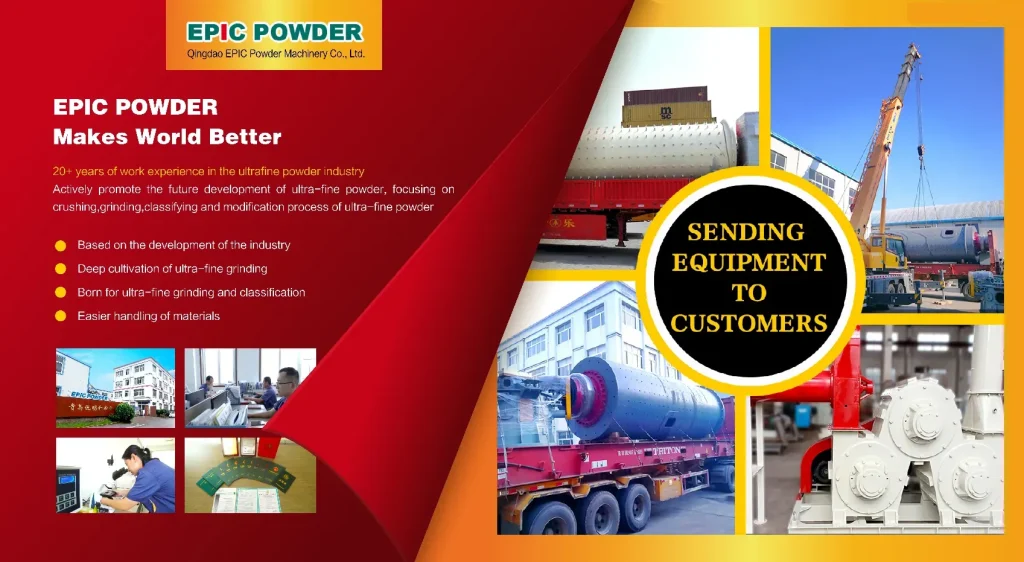
As a leading manufacturer of grinding equipment, Epic Powder Machinery offers ring roller mills that embody the latest advancements in powder processing technology.
Key Advantages of Epic Powder Ring Roller Mills:
- Exceptional fineness: Produces 325–2500 mesh product fineness in a single pass, with final fineness reaching D97 ≤ 5 μm
- Superior efficiency: Much higher production efficiency than Raymond mills and jet mills—some models deliver more than double the output per unit of power
- Energy savings: Significantly lower energy consumption compared to traditional grinding equipment, with documented savings of around 30% versus ball mills
- Low maintenance: Wear parts made from high‑hardness, wear‑resistant materials for extended service life
- Easy installation: Minimal civil engineering required—equipment can be operational quickly
- Environmental compliance: Complete negative pressure system with up to 99.9% dust collection efficiency
- Versatility: Suitable for a wide range of non‑metallic minerals including calcium carbonate, barite, talc, gypsum, limestone, calcite, dolomite, bentonite, and feldspar
Summary Comparison Table
| Feature | Raymond Mill | Ring Roller Mill |
|---|---|---|
| Fineness range | 80–425 mesh (up to 600 mesh with modifications) | 325–2500 mesh (D97 ≤ 3 μm) |
| Max material hardness | Mohs < 7 | Up to 9.2 (depending on model) |
| Energy consumption | Moderate | ~30% lower than ball/jet mills |
| Production efficiency | Baseline | Significantly higher (more than double in some cases) |
| Initial investment | Lower | Moderate |
| Maintenance cost | Moderate | Generally lower |
| Installation | Some civil work required | Minimal civil engineering |
| Dust collection | Standard | Up to 99.9% efficiency |
| Best for | Coarse to medium powders, soft materials, limited budgets | Ultra‑fine powders, harder materials, long‑term ROI |
Final Thoughts
The choice between a Raymond mill and a ring roller mill ultimately comes down to your specific production requirements:
- If you need standard fineness powders (80–400 mesh) for general applications and have a tighter budget, a Raymond mill may serve you well.
- If you are pursuing ultra‑fine powders (325–2500 mesh) , want to significantly reduce energy costs, and are looking for long‑term operational efficiency, the ring roller mill is the superior choice.
For mineral processors looking to stay competitive in today’s market—where finer particle sizes, lower energy consumption, and environmental compliance are increasingly important—the ring roller mill represents the future of grinding technology.
Ready to upgrade your grinding operation? Contact Epic Powder Machinery to discuss your specific requirements and find the right ring roller mill for your application.
Epic Powder
Epic Powder, 20+ years of experience in the ultrafine powder industry. Actively promote the future development of ultra-fine powder, focusing on crushing, grinding, classifying and modification process of ultra-fine powder. Contact us for a free consultation and customized solutions! Our expert team is dedicated to providing high-quality products and services to maximize the value of your powder processing.

“Thanks for reading. I hope my article helps. Please leave a comment down below.
You may also contact EPIC Powder online customer representative Zelda for any further inquiries.”
—— Jason Wang, Engineer