
How Much Does a Ring Roller Mill Cost Guide
If you are evaluating a ring roller mill for calcium carbonate, talc, barite, or another non-metallic mineral, the first question you will ask is the ring roller mill price. A market-typical ring roller mill in this class is usually quoted in the US$30,000–90,000 range (FOB), with the exact figure set by model, capacity, and configuration. This guide explains where that number comes from, the factors that decide your quote, and how the total cost of ownership compares with ball mills and jet mills.
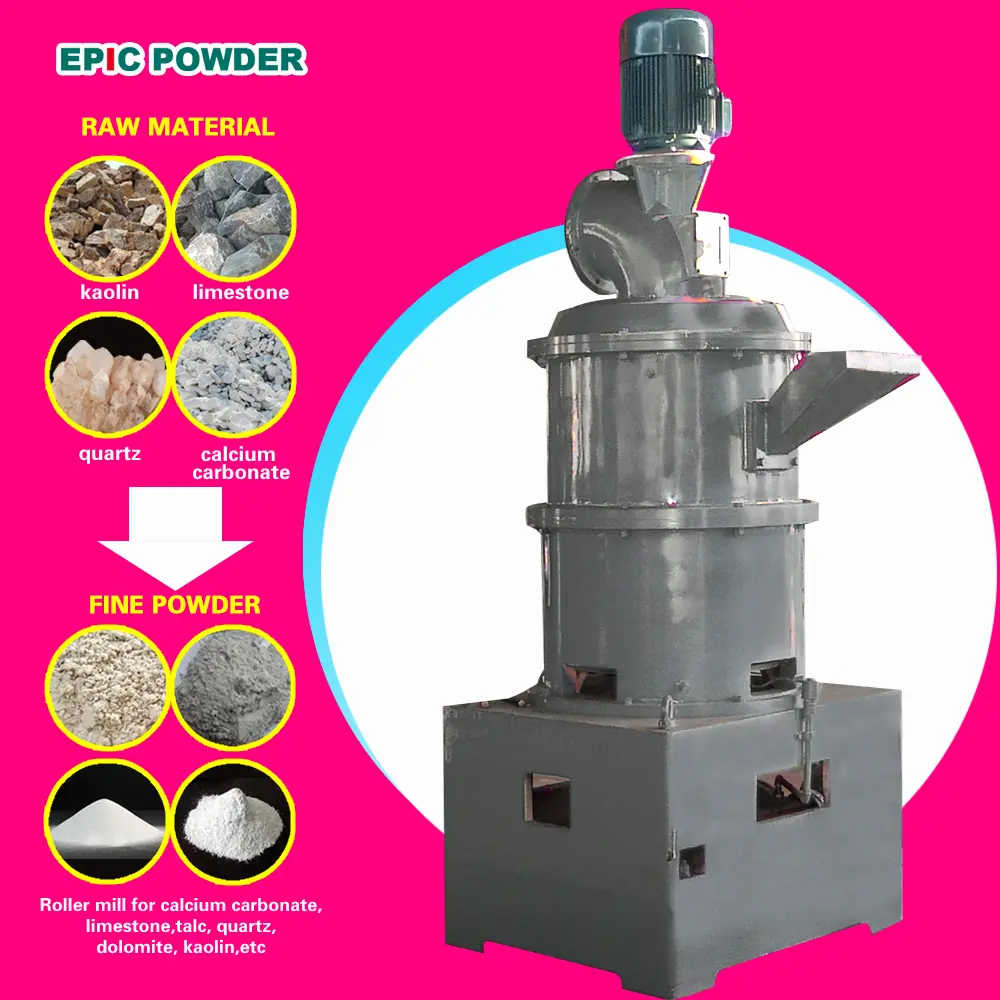
Ring Roller Mill Price: The Range at a Glance
For a ring roller mill producing 325–2500 mesh powder from non-metallic minerals, the market price is usually US$30,000–90,000 (FOB), depending on model, power, wear-part materials, and auxiliary systems. Epic Powder serves this segment with two models:
| Model | Capacity | Mill Motor | Typical Price Position |
| SRM800 | 0.5–4.0 t/h | 75 kW | Lower end of the range |
| SRM1000 | 1.0–8.0 t/h | 132 kW | Middle to upper end of the range |
The SRM800 fits smaller lines and first production runs. The SRM1000 moves more tonnage per hour, so it carries a higher sticker price but a lower cost per ton in continuous operation.
Keep one thing in mind: the mill itself is only part of the bill. The classifier, fan, dust collector, feed system, and control cabinet go on top, and together they are a large share of the total. That is why we quote a full system instead of publishing one flat price.
Why a Ring Roller Mill Has No Fixed Price
Standard equipment can be listed at one price. A ring roller mill cannot, because two buyers of the same model rarely need the same machine. One wants D97 ≤ 5 μm powder for coatings. Another only needs coarse 325 mesh filler for construction. If a supplier quotes you a price before asking about your material, capacity, and fineness, that number is a guess, not a real offer.
7 Factors That Decide the Price
1. Model and Capacity
Size sets both throughput and price. The SRM800 grinds roughly 0.5 to 4.0 tons per hour. The SRM1000 grinds 1.0 to 8.0 tons per hour and costs more up front because it produces more. Pick the size that matches your real output. A machine that is too small means buying twice. A machine that is too large means paying for capacity you never use.
2. Motor Power
The SRM800 runs on a 75 kW mill motor. The SRM1000 runs on 132 kW, and the classifier and fan motors sit on top of that. More power raises the purchase price, but a motor matched to your output uses less energy per ton. Price and cost are two different numbers. A slightly more expensive, better-matched motor usually costs less to run.
3. Grinding Ring and Roller Material
The grinding ring and rollers do the heavy work and wear down over time. Mills built with high-hardness, wear-resistant parts cost more now but need fewer replacements later. If your material is abrasive, better wear parts are what keep you running instead of paying for constant downtime. Our roller tire replacement and wear guide shows the wear cycles you can expect.
4. Target Fineness and Classifier
These mills produce 325 to 2500 mesh, and the fine powder can reach D97 ≤ 5 μm. Finer output needs a more precise classifier, which raises the price. The advantage is that a ring roller mill reaches fine powder in one pass, so you skip the cost of a separate regrinding stage. Our roller mill product overview explains how it hits those results.
5. Auxiliary Systems
The fan, dust collector (99.9% efficiency, running under negative pressure), feed system, and control cabinet are all part of a real production line. A bare mill costs less, but it does not put you into production. The complete package is what starts earning money after installation.
6. Material Being Processed
What you feed the mill changes what goes inside it. Soft talc, medium-hard calcite, and abrasive quartz put very different demands on the grinding ring, rollers, and lining. Harder materials need reinforced wear parts, which changes both the configuration and the price.
7. Installation, Civil Work, and After-Sales
A ring roller mill does not need a multi-layer steel platform or heavy civil work, so site preparation stays cheap compared to some alternatives. After-sales support, shipping distance, and local commissioning all affect the final landed cost. When you compare suppliers, compare the total, not the machine price alone.
How the Cost Compares
When people ask about ring roller mill price, they usually want to know whether the total spend is worth it. At the same fineness, a ring roller mill is more efficient, uses less energy, and costs less to run than a ball mill, impact mill, jet mill, or stirred mill. At the same capacity, it needs less capital and pays for itself faster. Our ball mill vs. roller mill comparison breaks down the energy and cost difference in detail.
Total Cost of Ownership: What Actually Decides the Purchase
The sticker price is the headline, but the running cost is the real decision. Three things matter most:
Energy. An optimized motor and high grinding efficiency lower your cost per ton over the life of the machine. See how roller mills cut production costs with energy-efficient grinding.
Wear parts. Grinding rings and rollers are consumables. Higher-quality parts mean longer replacement cycles and less downtime.
Uptime. A mill that runs clean and does not stop unexpectedly keeps your line running and your money coming in.
How to Get an Accurate Quote
To get a real ring roller mill price instead of a placeholder, have these details ready before you contact us:
a. The material, and its hardness or abrasiveness if you know it
b. Target fineness (mesh or D97)
c. Required capacity (tons per hour)
d. Feed size and moisture
e. The application or industry (plastics filler, coatings, paper, ceramics, and so on)
f. Your location, for delivery and commissioning
A supplier that asks for these details is doing the job right. Without them, any price you are given is only a guess.
Conclusion
The price of a ring roller mill depends on the model, capacity, fineness, wear part material, and auxiliary equipment you choose, which is why there is no single fixed number. What matters more is the cost per ton over the life of the machine, and on that measure the ring roller mill’s efficiency and low energy use beat ball mills and jet mills. If you are ready to price a system for your material, send us your specs and we will build you a configured quote.

“Thanks for reading. I hope my article helps. Please leave a comment down below. You may also contact EPIC Powder online customer representative Zelda for any further inquiries.”
— Emily Chen, Engineer

