Roller Mill vs Jet Mill: Which Fine Grinding System Fits Your Material?
Choosing between Epic Powder’s SRM ring roller mills and a jet mill starts with one question: how fine does your powder need to be, and at what capacity? The SRM800 and SRM1000 grind with mechanical force. Jet mills grind with high-velocity air streams. The difference in mechanism drives every other decision, from energy use to particle shape.
How the Two Mills Grind
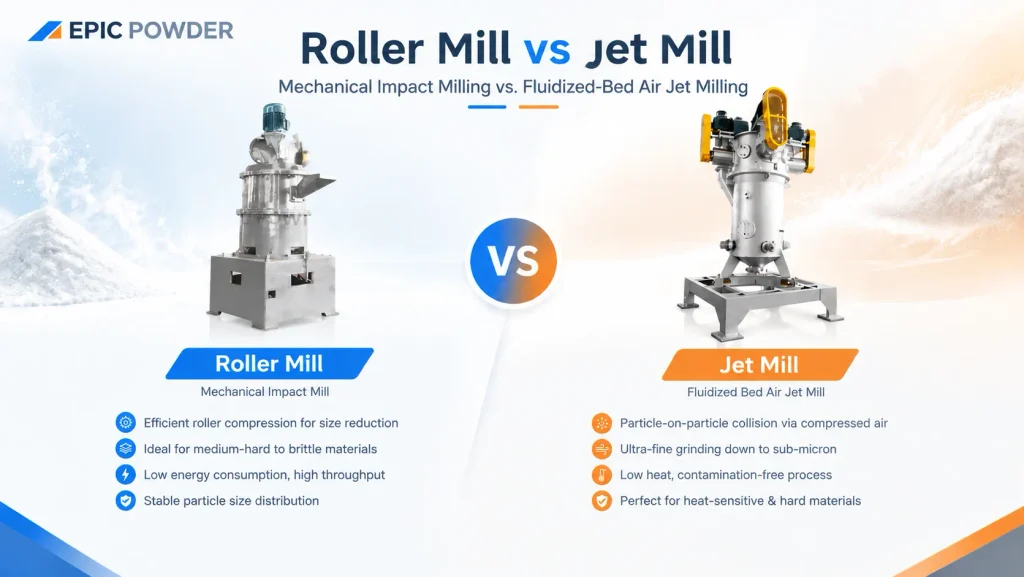
The SRM ring roller mill crushes material between rotating rollers and a stationary grinding ring. The rollers apply pressure and shear, breaking particles into smaller sizes. Both the SRM800 and SRM1000 accept feed sizes below 10-20 mm and run continuously. This mechanical process suits non-metallic minerals like calcium carbonate, talc, bentonite, and limestone.
A jet mill accelerates particles in high-speed air jets and lets them collide with each other. No grinding media touch the material, so contamination stays low. The process also keeps temperatures down, which helps heat-sensitive materials. Epic Powder’s jet mill reaches much finer sizes than the SRM series, producing powders from 2 to 45 microns.
Fineness and Particle Shape
Epic Powder’s SRM800 and SRM1000 both produce powders from approximately 5 to 45 microns. This range covers most filler, coating, plastics, rubber, and construction applications. For example, a 10-micron calcium carbonate powder for PVC or paint fits within the SRM range.
Epic Powder’s jet mill produces powders from 2 to 45 microns. This range overlaps with the finer end of the SRM range but extends further down to 2 microns. Jet mills also create more spherical particles with a narrower size distribution. This shape matters in applications like 3D printing, advanced ceramics, and pharmaceutical aerosols.
Energy Use
The SRM800 has an installed power of approximately 127-138.5 kW, including the mill motor, classifier motor, and fan motor. The SRM1000 has an installed power of approximately 209-237 kW. Actual energy consumption per ton depends on the material, feed size, target fineness, and operating conditions.
Jet mills rely on compressed air at high pressure. The total energy cost includes both the mill and the compressor plant. For many minerals, this makes the jet mill more energy-intensive per ton than the SRM series when producing similar fineness.
Investment and Running Costs
A complete jet mill line typically costs more than an SRM ring roller mill of similar nominal capacity. The jet mill needs supporting equipment: compressors, dryers, dust collectors sized for higher air volumes, and often a classifier. SRM systems are simpler to install and integrate into existing plants. Wear parts such as rollers and rings are also generally less expensive to replace than compressor maintenance.
Material Fit
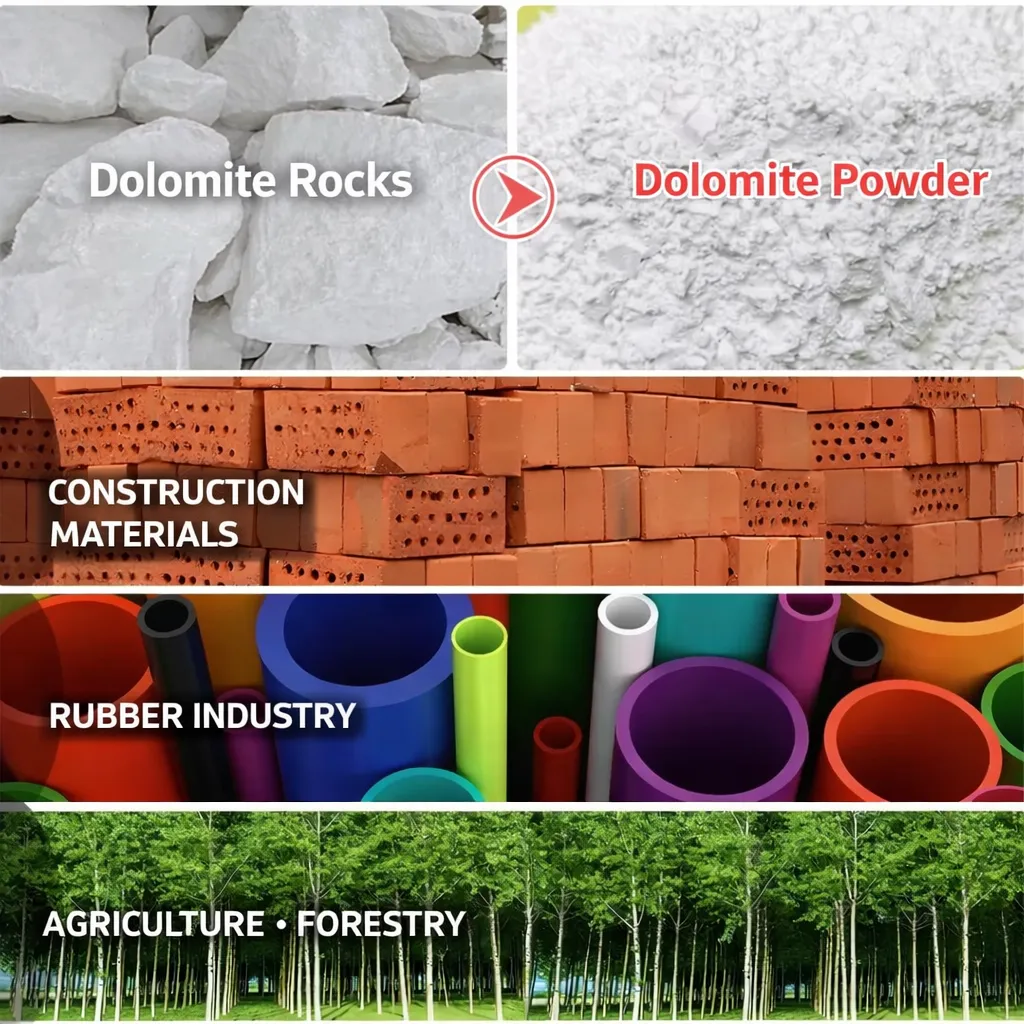
The SRM800 and SRM1000 handle materials with moisture below 5% and suit non-metallic minerals with Mohs hardness up to common industrial levels. They work for calcium carbonate, barite, dolomite, feldspar, and petroleum coke. Jet mills suit materials that must stay pure, avoid heat, or reach extreme fineness, such as ceramics, pigments, toner, pharmaceuticals, and some battery materials.
Capacity
The SRM800 produces 0.5-4.0 tons per hour, depending on material and fineness. The SRM1000 produces 1.0-8.0 tons per hour under the same variables. Jet mills usually operate at smaller capacities, often below 2 tons per hour for fine products. If your target is several thousand tons per month, the SRM1000 keeps unit costs lower.
When to Choose Each
Choose an SRM800 or SRM1000 when you need approximately 5-45 micron powder, continuous production, and low cost per ton. Pick the SRM800 for smaller output requirements and the SRM1000 for higher capacity. These mills fit standard industrial fillers, coatings, plastics, rubber, and building materials.
Choose a jet mill when purity, narrow particle distribution, or particle sizes down to 2 microns drive your product value. It fits high-end ceramics, electronics materials, pharmaceuticals, and specialty chemicals. The higher operating cost is acceptable when the product sells at a premium.
Some plants use both. They run an SRM mill for coarse and medium grinding, then send the fine fraction to a jet mill for final polishing. This hybrid approach can cut total energy use while still reaching top fineness.
Get a Material Test
Epic Powder tests customer materials and recommends the most economical grinding path based on fineness, capacity, and operating budget. Contact us to discuss your SRM800, SRM1000, or jet mill requirements.
Epic Powder
Epic Powder designs grinding and classifying systems for minerals, chemicals, food, and pharmaceuticals. With more than 20 years of powder processing experience, we match the right mill to your target particle size and capacity. Tell us about your material and we will recommend a tested solution.

“Thanks for reading. I hope my article helps. Please leave a comment down below.
You may also contact EPIC Powder online customer representative Zelda for any further inquiries.”
— Emily Chen, Engineer