Ring Roller Mill for Quartz and Feldspar
Why Quartz and Feldspar Require Specialized Milling Equipment
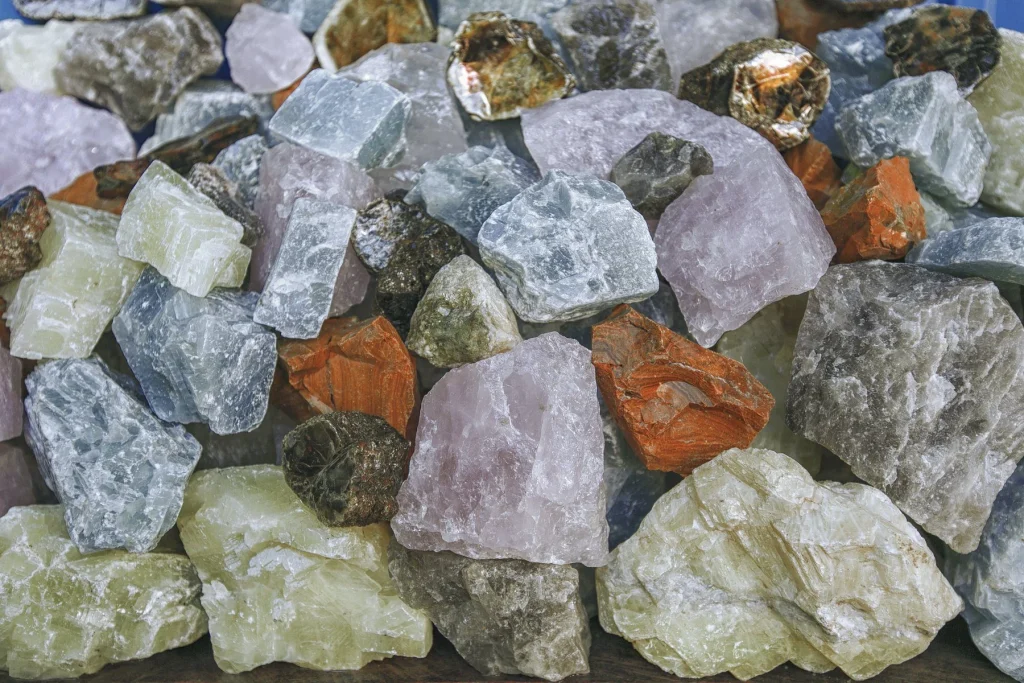
Quartz and feldspar hold a central position in industrial applications, valued primarily for two properties: high hardness—rated at approximately 7 on the Mohs scale—and chemical stability. These minerals serve as essential raw materials in sectors such as glass, ceramics, and coatings. However, this same hardness introduces practical difficulties in grinding. Conventional mills processing such minerals commonly encounter three persistent issues: accelerated equipment wear, low operational efficiency, and product contamination. When grinding rollers and chamber linings repeatedly contact high-hardness particles, their wear rate increases significantly compared to processing softer materials. Frequent part replacements reduce effective production time and raise maintenance costs. Furthermore, metal contamination from worn components can compromise the whiteness and purity of the final powder—a critical concern for industries like glass and ceramics, where even trace impurities affect product quality.
Thus, the challenge in processing quartz and feldspar is not merely whether grinding is possible, but whether it can be achieved consistently while controlling wear, preserving purity, and maintaining efficiency. This requires equipment designed with specific attention to structural durability and material selection.
The Ultimate Solution: The Ring Roller Mill
The ring roller mill addresses these challenges through design choices tailored to high-hardness minerals. Its technical approach focuses on two core objectives: minimizing wear and stabilizing particle size distribution.
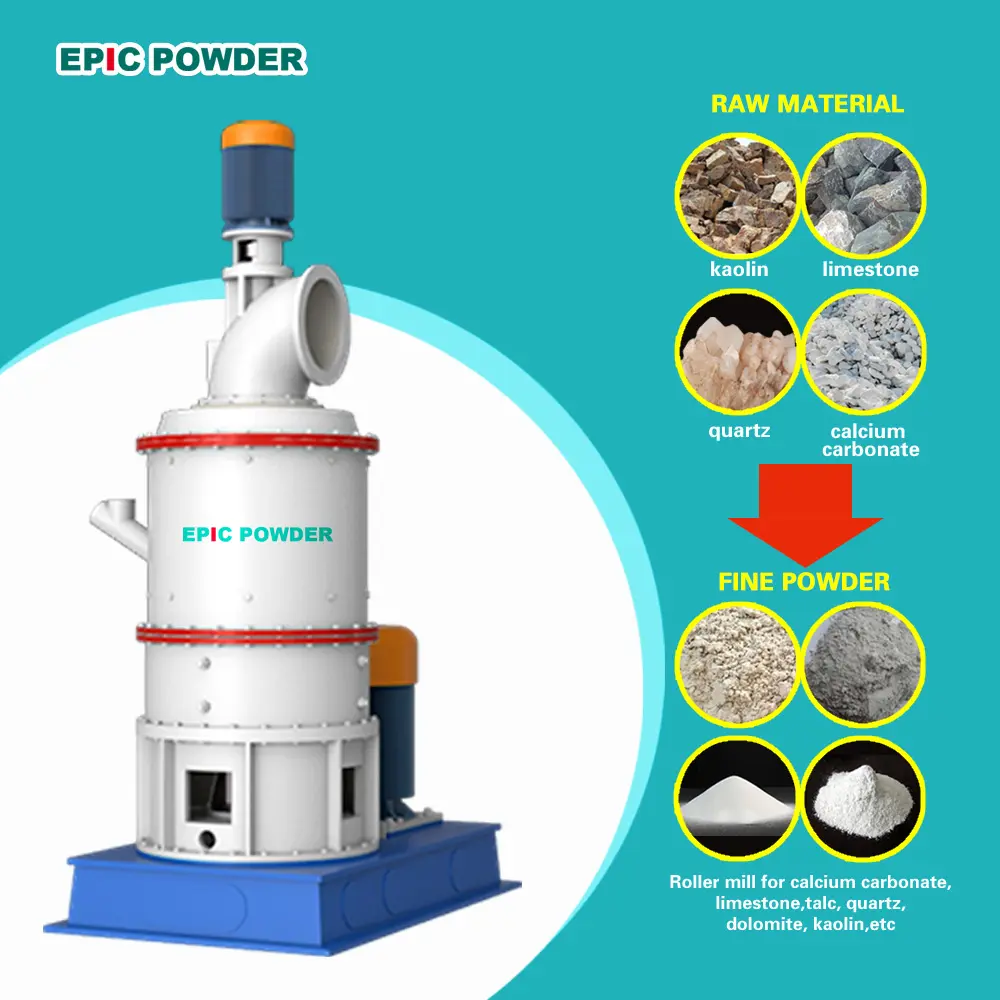
Unlike conventional mills, the ring roller mill operates on a forced compression mechanism, where materials are ground between rotating rings and rollers under controlled pressure. Grinding components are fabricated from high-grade wear-resistant alloys, and the mill structure emphasizes sealing and operational stability. These features collectively enable consistent processing of hard minerals like quartz and feldspar over extended production cycles, reducing downtime and maintaining product quality.
How a Ring Roller Mill Works
The Principle of Compression and Shearing
The ring roller mill grinds high-hardness minerals through two coordinated actions: compression and shearing.
Compression occurs when material is pressed between the rotating grinding ring and multiple rollers under mechanical force. This pressure fractures the mineral particles. Simultaneously, the rollers impart a shearing force that further breaks down particles without generating excessive heat. Together, these mechanisms achieve fine grinding while minimizing stress on equipment components.
A key advantage of this design is the reduced contact friction compared to impact-based mills. Because wear is distributed across larger grinding surfaces, the mill maintains stable performance over longer periods, even when processing abrasive minerals.
| Feature | Benefit |
|---|---|
| Compression mechanism | Effectively fractures hard minerals |
| Shearing action | Enables controlled particle size reduction |
| Roller and ring configuration | Reduces localized wear |
Air Classification Integration
To achieve precise particle size control, the ring roller mill incorporates an integrated air classifier. This system operates as follows:
- Air flows upward through the grinding chamber, carrying fine particles toward the classifier.
- The classifier rotor separates particles based on size; only those meeting the target specification exit as finished product.
- Oversized particles return to the grinding zone for further processing.
This closed-loop system ensures consistent particle size distribution and reduces the need for external screening equipment. For industries requiring uniform mineral powders—such as glass manufacturing or ceramic production—this integration helps maintain product consistency without additional processing steps.
Key Advantages of Using Ring Roller Mill for Quartz and Feldspar
1. Superior Wear Resistance and Low Operating Cost
Processing quartz and feldspar accelerates wear in conventional milling equipment, leading to frequent maintenance and replacement costs. The ring roller mill addresses this through the use of wear-resistant materials in its grinding components and a design that distributes mechanical stress across larger surfaces.
Field data indicate that under similar operating conditions, ring roller mills typically extend the service life of grinding parts compared to traditional Raymond mills. This translates to fewer interruptions, reduced consumable costs, and lower overall operating expenses.
2. High Purity Processing (Low Iron Contamination)
For applications in glass, ceramics, and high-grade fillers, iron contamination directly affects product appearance and performance. The ring roller mill minimizes this risk through two design choices: the use of non-metallic or low-iron liners in contact zones, and a grinding mechanism that reduces metal-to-mineral friction.
By limiting the introduction of metallic contaminants during processing, the mill helps preserve the natural whiteness and chemical purity of quartz and feldspar powders—an essential requirement for manufacturers serving quality-sensitive markets.
3. Energy Efficiency and High Capacity
Energy consumption represents a significant portion of operating costs in mineral grinding. The ring roller mill improves energy efficiency by applying direct compression force rather than relying on impact or cascading media. This approach converts a higher proportion of input energy into effective particle breakage.
Additionally, the integrated air classifier removes fine particles immediately upon reaching target size, preventing over-grinding and reducing the energy wasted on processing material that has already met specifications. For large-scale operations, this combination of efficient energy use and high throughput offers measurable cost advantages.
Applications: Where Do Ground Quartz and Feldspar Go?
Glass Industry
In glass manufacturing, quartz supplies the silica content essential for structural strength and optical clarity, while feldspar acts as a flux, lowering the melting temperature during batch processing. Particle size consistency is critical here: uniform powder ensures even melting and reduces defects such as bubbles or inhomogeneities. The ring roller mill’s ability to produce narrow particle size distributions directly supports these quality requirements.
Ceramic and Sanitary Ware
For ceramics and sanitary ware, feldspar promotes vitrification during firing, contributing to hardness and water resistance, while quartz adds thermal stability and mechanical strength. The uniformity of ground material influences green body density, firing behavior, and final product finish. Consistent powder from ring roller milling helps manufacturers achieve reliable results across production batches.
Paints, Coatings, and Fillers
In paints and coatings, finely ground quartz and feldspar serve as functional fillers that improve abrasion resistance, weatherability, and film integrity. Low iron content is particularly important in this sector, as impurities can affect color consistency in pigmented systems. The ring roller mill’s combination of fine grinding and purity control makes it suitable for producing mineral powders that meet the performance standards of modern coating formulations.
Epic Powder: Your Trusted Partner in Mineral Processing
Customized Solutions
At Epic Powder, we recognize that effective grinding of high-hardness minerals requires more than standard equipment—it demands configuration aligned with specific material properties and production goals. Our approach begins with analyzing the customer’s raw material characteristics, such as feed size, moisture content, and target fineness. Based on this assessment, we recommend ring roller mill configurations tailored to the application, whether the priority is maximum throughput, minimal contamination, or extended component life.
After-Sales Support and Wear Parts Supply
Processing abrasive minerals inevitably involves wear, even with well-designed equipment. To support continuous operation, Epic Powder provides structured after-sales services, including maintenance guidance, troubleshooting support, and a reliable supply of wear parts engineered for high-hardness applications. Our aim is to help customers maintain consistent production schedules while managing operating costs effectively.
Case Study
A mineral processing company operating a quartz grinding line sought to address three limitations in their existing setup: high wear rates leading to frequent downtime, inconsistent product fineness affecting downstream quality, and elevated iron contamination levels that restricted market applications.
After evaluating available technologies, the company selected a ring roller mill configured for high-hardness materials. The selection was based on the mill’s wear-resistant component design, integrated classification system, and documented performance in similar applications.
Results Achieved
Following installation and commissioning, the following outcomes were observed:
- Reduced wear-related downtime: The service interval for grinding components extended significantly compared to the previous equipment, reducing maintenance frequency.
- Consistent particle size: Product fineness remained within specified ranges across production shifts, with the integrated classifier maintaining uniform distribution.
- Lower iron contamination: Post-processing analysis showed reduced metallic impurity levels, meeting requirements for glass-grade quartz applications.
- Improved energy efficiency: Energy consumption per ton of finished product decreased compared to the previous milling method.
- Increased throughput: The line achieved higher output without requiring additional equipment or floor space.
This case illustrates how a properly configured ring roller mill can address the specific challenges associated with quartz and feldspar grinding.
Frequently Asked Questions (FAQ) About Ring Roller Mills
Can a ring roller mill grind quartz without damaging the equipment?
Yes. The ring roller mill is designed to handle high-hardness minerals through compression-based grinding, which reduces impact stress on components. Wear-resistant materials and structural design further contribute to equipment durability under continuous operation.
What is the maximum feeding size for feldspar?
For most ring roller mill configurations, the recommended maximum feed size for feldspar is between 15 and 20 millimeters. This range allows the mill to operate efficiently without risking blockages or excessive wear. Larger feed particles should be reduced through pre-crushing before entering the mill.
How do I choose between a ball mill and a ring roller mill for feldspar?
The choice depends on specific operational priorities:
- A ring roller mill is generally preferable for:
- Higher energy efficiency and lower operating costs
- Reduced iron contamination in finished products
- Continuous, high-capacity processing
- A ball mill may be selected when:
- Extremely narrow particle size distributions are required
- The application involves small-batch or specialized material processing
For most feldspar grinding applications where purity, wear control, and production efficiency are priorities, the ring roller mill offers distinct operational advantages.
Epic Powder
At Epic Powder, we offer a wide range of equipment models and tailor solutions to meet your specific needs. Our team has more than 20 years experience in various powders processing. Epic Powder is specialized in fine powder processing technology for mineral industry, chemical industry, food industry, pharama industry, etc.
Contact us today for a free consultation and customized solutions!

“Thanks for reading. I hope my article helps. Please leave a comment down below.
You may also contact EPIC Powder online customer representative Zelda for any further inquiries.”
— Emily Chen, Engineer