Ring Roller Mill for Dolomite Grinding: Fineness Targets by Application, Energy Performance, and Production Line Setup
Dolomite is one of the most widely processed non-metallic minerals in the world — and one of the most application-sensitive. A steel plant wants coarse dolomite at 40-100 mesh for fluxing. A paint manufacturer wants 1,250-mesh powder with tight D97 control for hiding power. A glass manufacturer wants something in between, with strict limits on silica and iron impurities. These three producers need different equipment configurations, different classifier settings, and different auxiliary system designs — even though they are all grinding the same mineral.
The ring roller mill handles this range better than most alternatives. Its multi-layer roller-ring grinding mechanism produces consistent fineness across the 100-3,250 mesh range, and the integrated dynamic classifier makes it practical to switch between specifications without equipment changes. Compared to a ball mill, it uses 20-35% less specific energy for equivalent fineness and requires a simpler installation. Compared to a Raymond mill, it achieves finer and more consistent product with a steeper PSD curve.
This article covers dolomite’s application-specific fineness requirements, how a ring roller mill meets them, the energy and installation comparison with alternatives, and what a complete dolomite grinding line looks like in practice.
Dolomite Applications and Their Fineness Requirements
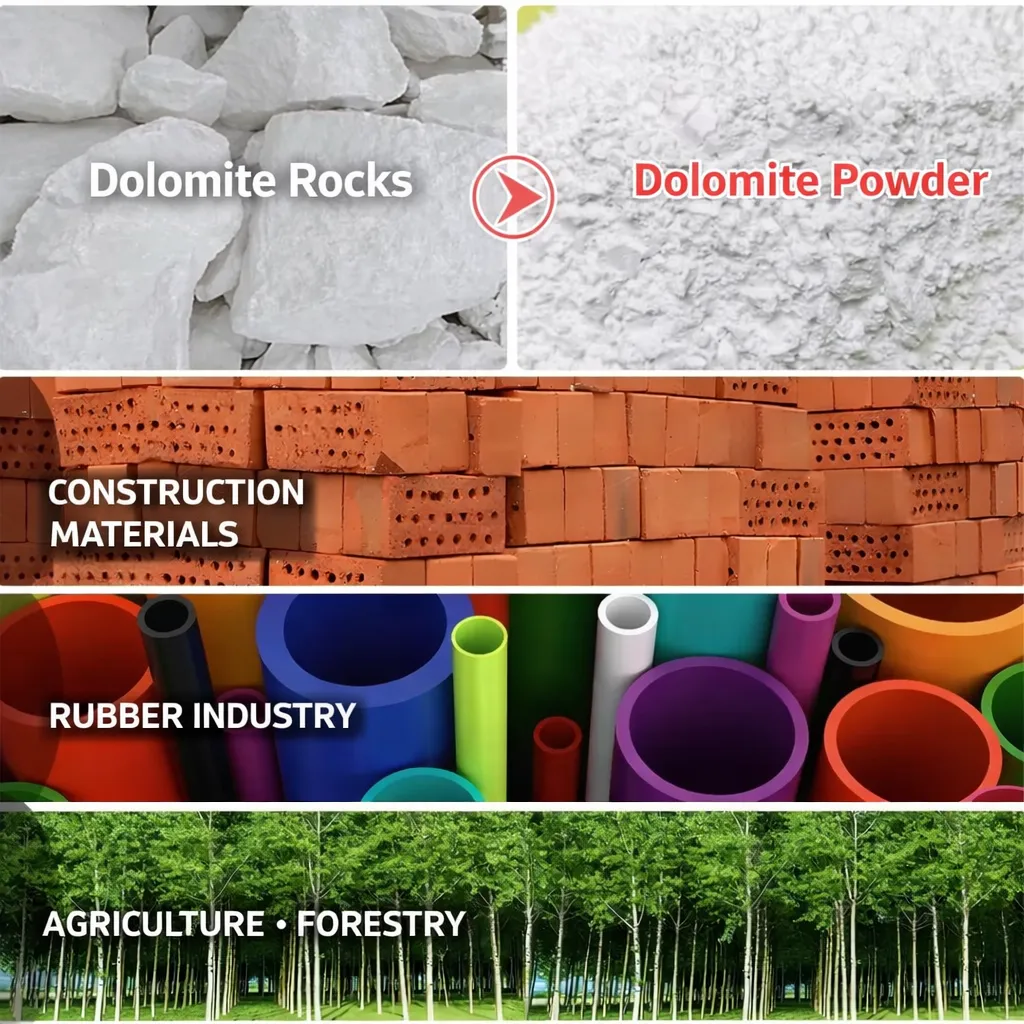
Getting the fineness wrong is expensive in both directions. Too coarse and the product fails incoming inspection at the customer; too fine and you are spending energy to produce a specification you are not being paid for. The table below maps the major dolomite markets to their standard fineness targets.
| Industry / Application | Typical Mesh Range | Typical D97 Target | Key Quality Requirement |
| Steel & metallurgy (flux) | 40-100 mesh | 800-400 um | MgO + CaO content; low SiO2; particle size controls melting rate |
| Construction (aggregate fill) | 80-200 mesh | 180-75 um | Particle size distribution for workability; low impurities |
| Agriculture (soil amendment) | 200-400 mesh | 75-38 um | Fineness controls dissolution rate; Ca:Mg ratio specified |
| Glass & ceramics | 300-600 mesh | 50-25 um | Low Fe2O3 (<0.05%); consistent CaMg ratio for batch chemistry |
| Rubber & plastics filler | 600-1,250 mesh | 25-12 um | D97 control for mechanical properties; surface treatment often required |
| Paint & coatings filler | 1,250-2,500 mesh | 12-6 um | Narrow PSD for hiding power and sheen; oil absorption control |
| Paper coating & filler | 2,000-3,250 mesh | 8-4 um | D97 strictly below 10 um; brightness above 94 GE |
Specifications vary by customer and region. Verify against your buyer’s incoming inspection requirements before setting production parameters.
The ring roller mill covers the full range in this table — 100 mesh through 3,250 mesh — using the same mechanical design with classifier speed as the primary control variable. Most competing technologies cover only part of this range. Ball mills are practical up to about 400-600 mesh before energy cost becomes prohibitive. Raymond mills are efficient in the 80-400 mesh range but lose sharpness above 600 mesh. For producers supplying multiple markets from one production line, the ring roller mill’s range is a real operational advantage.
How a Ring Roller Mill Processes Dolomite
Dolomite enters the ring roller mill through a controlled feed system and falls between the uppermost layer of grinding rollers and the fixed grinding ring. As the roller assembly rotates, material is drawn into the gap between roller and ring where three forces act simultaneously — impact, compression, and shear. These three mechanisms working together are more energy-efficient than the single-mechanism attrition of a ball mill or the predominantly compressive action of a roller press.
The material-bed principle is important here. A thin cushion layer of crushed dolomite always sits between the roller face and the ring surface. Particles grind primarily against each other rather than directly against the metal surfaces. This reduces metal wear and, for applications where iron contamination matters (glass and ceramics production), keeps Fe contribution from the grinding surfaces below measurable levels.
After passing through four or more progressive grinding stages in the multi-layer roller assembly, the material falls to a collection tray at the base of the mill and is carried upward by the process airflow to the integrated dynamic classifier. The classifier wheel speed determines the cut point: particles below the target size pass through the wheel to the product collection system; oversized particles are thrown back to the grinding zone. This closed-loop classification eliminates oversized particles from the product and prevents over-grinding of already-fine material.
Classifier Speed and Fineness — The Control Relationship
The classifier wheel speed is the primary fineness control variable. Higher RPM produces finer product by rejecting larger particles back to the grinding zone. The relationship is not perfectly linear — it varies with dolomite hardness, feed moisture, and feed rate — but it is reproducible enough that a validated speed setting will produce the same product D97 consistently across production shifts.
Feed rate has a secondary effect: higher feed rate increases particle concentration in the classification zone, which can slightly coarsen the cut point through particle crowding. For products at the fine end of the specification (2,000 mesh and above), running at a controlled, slightly reduced feed rate improves D97 consistency. For coarser products (200-600 mesh), feed rate can be maximised for throughput without affecting specification compliance.
Ring Roller Mill vs. Ball Mill vs. Raymond Mill for Dolomite
Three technologies are in common use for dolomite grinding in the 200-3,250 mesh range. Each has a different energy profile, a different PSD characteristic, and a different installation requirement.
| Factor | Ring Roller Mill | Ball Mill | Raymond Mill |
| Fineness range | 100-3,250 mesh | 100-600 mesh (practical) | 80-600 mesh |
| Specific energy (kWh/t) at 600 mesh | ~28-35 | ~40-55 | ~32-42 |
| Specific energy (kWh/t) at 1,250 mesh | ~45-60 | Not practical (agglomeration) | ~65-85 |
| PSD sharpness above 1,000 mesh | Excellent (adjustable classifier) | Poor (screen-limited) | Moderate |
| Fe contamination from mill | Very low (material-bed principle) | Moderate (ball and liner wear) | Low-moderate |
| Foundation requirement | Simple flat pad | Reinforced, multi-storey structure | Moderate foundation |
| Typical installation time | 5-7 days | 3-6 weeks | 1-2 weeks |
| Best application range | 200-3,250 mesh, especially fine grades | Coarse to medium (80-400 mesh) | 80-600 mesh, moderate volume |
The energy advantage of the ring roller mill over the ball mill grows as the target fineness gets finer. At 200-400 mesh, the difference is meaningful but not dramatic. Above 1,000 mesh, ball milling becomes impractical for dolomite because the high energy input required causes temperature rise and progressive agglomeration, while the ring roller mill continues to operate efficiently with the integrated classifier controlling the upper particle size limit.
Setting Up a Dolomite Grinding Line with a Ring Roller Mill
The ring roller mill does not operate as a standalone machine. The upstream feed system and the downstream classifier and collection system together determine whether the mill performs at its design specification. A correctly designed auxiliary system can contribute as much to product quality and energy efficiency as the mill itself.
Step 1: Define Feed Size and Pre-Crushing Requirements
The ring roller mill accepts feed up to 10-20 mm depending on the model. If your quarried dolomite comes in larger sizes — which is typical for run-of-mine material — a jaw crusher and/or impact crusher upstream reduces the feed to the required inlet size. Pre-screening to remove fines before the mill improves efficiency: material that is already fine enough passes through the classifier immediately without consuming grinding energy, but it adds to the circulating load if fed directly to the mill without screening.
Step 2: Size the Mill for Your Throughput and Fineness Target
The EPIC Powder SRM series ring roller mills cover throughputs from 0.5 t/h (SRM800, suitable for pilot production and speciality fine grades) to 3-20 t/h (SRM1680, suitable for large-scale dolomite powder production for construction and industrial markets). Throughput and fineness are inversely related for a given mill model — producing 3,250-mesh powder requires longer classification time and therefore lower throughput than producing 600-mesh powder. The right model depends on your specific combination of required fineness and daily production volume.
| Model | Mill Motor (kW) | Classifier Motor (kW) | Product Fineness (mesh) | Capacity Range (t/h) |
| SRM800 | 75 | 15-18.5 | 100-3,250 | 0.5-4.0 |
| SRM1000 | 132 | 22-30 | 100-3,250 | 1.0-8.0 |
| SRM1250 | 185 | 37-60 | 100-3,250 | 2.0-12 |
| SRM1680 | 315 | 55-92.5 | 100-3,250 | 3.0-20 |
Capacity depends on material hardness, target fineness, and feed moisture. Contact EPIC Powder for dolomite-specific throughput projections at your target mesh.
Step 3: Configure the Classifier and Collection System
The integrated classifier is configured at commissioning for your target fineness and does not require manual adjustment during normal production. Downstream, the product is collected by a pulse bag filter — standard specification is 99.9% collection efficiency, which keeps workplace dust levels within regulatory limits and maximises product yield. A bag filter also allows recovery of the finest fraction that a cyclone would pass to exhaust.
For paint-grade and paper-grade dolomite (1,250 mesh and above), a two-stage collection system is worth considering: a primary cyclone captures the bulk of the product, and a secondary bag filter recovers the fine fraction that the cyclone misses. This improves overall yield on the expensive fine fraction and avoids losing the highest-value material to the dust collector exhaust.
Step 4: Establish and Document Your Process Recipe
Once the system is commissioned and producing on-spec product, document the classifier speed, feed rate, and airflow settings as a named recipe. Ring roller mill performance is highly reproducible with consistent parameters — the same recipe will produce the same D97 consistently across shifts and operators. If your line produces multiple grades, create a separate validated recipe for each grade and include the grade-change procedure (how long to run before sampling confirms the new grade has reached steady state).
Production Results: Two Dolomite Processing Applications
CASE STUDY 1
Glass-Grade Dolomite at 400 Mesh — Reducing Fe Contamination from Mill Wear
The situation
A dolomite processor supplying the glass manufacturing market was running a ball mill and screen circuit for 400-mesh product. Glass customers specified Fe2O3 below 0.05% in the dolomite powder — a strict limit because iron causes colour in glass. Their ball mill was producing Fe2O3 at 0.06-0.08% in the milled product, above spec, attributed to iron liberated from the steel balls and liner during grinding. Replacing the ball mill with ceramic liners and ceramic balls was evaluated but found to be cost-prohibitive for their throughput requirement.
The solution
EPIC Powder Machinery supplied an SRM1000 ring roller mill with standard alloy steel rollers and ring. The material-bed grinding principle significantly reduces direct metal-to-mineral contact compared to ball milling — the rollers ride on a cushion layer of crushed dolomite rather than making direct metal-to-mineral impact.
Results
Fe2O3 in product: 0.038% — within the glass customer’s 0.05% limit
Product fineness: D97 42 um (equivalent to 400 mesh), consistent across all production shifts
Specific energy: 31 kWh/t at 400 mesh, down from 47 kWh/t on the ball mill circuit — 34% reduction
Installation: completed on a flat concrete pad in 6 days without reinforced foundation works

CASE STUDY 2
Paint-Grade Dolomite at 1,250 Mesh — Achieving Tight D97 for Coatings Market
The situation
A non-metallic mineral processor wanted to enter the paint and coatings filler market with a 1,250-mesh dolomite product. Their existing equipment was a Raymond mill, which could reach approximately 800 mesh on dolomite with reasonable throughput but could not consistently hit D97 below 15 um — the paint customers’ specification. Two consecutive tests on their Raymond mill showed D97 of 18 um and 22 um on different days, indicating inconsistent classifier performance.
The solution
EPIC Powder Machinery conducted a material trial at the R&D facility using the customer’s dolomite feed (Mohs hardness 3.5-4, feed size below 10 mm). The SRM1250 was configured at 5,200 rpm classifier speed and 185 kW mill motor load, achieving the target fineness at 2.8 t/h throughput. The customer attended the trial and collected samples for independent laser diffraction analysis.
Results
D50: 5.8 um
D97: 12.4 um — within the paint customer’s 15 um maximum on all trial samples
Batch-to-batch consistency: D97 varied by less than 1.5 um across six consecutive sampling intervals during the 4-hour trial — significantly tighter than the Raymond mill’s 4 um variation
Oil absorption: 24 g/100g — acceptable for standard architectural paint formulations
Equipment order: placed within three weeks of the trial
| Processing Dolomite — or Another Non-Metallic Mineral? EPIC Powder Machinery’s application engineers size and configure ring roller mill systems for dolomite, calcium carbonate, talc, barite, and other non-metallic minerals. Tell us your feed size, target fineness (mesh or D97), and production volume and we will recommend a specific SRM model and auxiliary configuration.We offer free material trials at our R&D facility and provide specific energy consumption data for your feed material before you commit to equipment. Request a Free Process Consultation: www.rollermill.net/contact Explore Our Dolomite Grinding Solutions: www.rollermill.net |
Frequently Asked Questions
What fineness can a ring roller mill achieve for dolomite, and how does it compare to a ball mill?
A ring roller mill covers the 100-3,250 mesh range for dolomite — from coarse construction-grade material down to fine paint and paper coatings filler. A ball mill’s practical upper limit for dolomite is around 400-600 mesh; above this, the energy cost rises steeply and agglomeration becomes a problem as the material heats during extended grinding. At 600 mesh, the ring roller mill typically uses 25-35% less specific energy (kWh per tonne) than a ball mill for the same dolomite. The energy advantage grows as fineness increases. Above 1,000 mesh, the ring roller mill with its integrated dynamic classifier is the only practical dry grinding option for dolomite at production scale — ball milling is not viable at this fineness for this material.
How does the ring roller mill control dolomite particle size distribution — specifically D97?
The integrated dynamic classifier is the primary D97 control mechanism. The classifier wheel spins at a set speed: higher speed produces finer product by rejecting larger particles back to the grinding zone; lower speed allows larger particles through to product. D97 is a function of classifier wheel speed, airflow velocity, and feed rate. For a given dolomite and target fineness, a validated combination of these three parameters produces a consistent D97 across production runs. EPIC Powder’s ring roller mills have PID-controlled classifier drive systems that hold wheel speed at the set point with minimal variation, which is why batch-to-batch D97 consistency is tight — typically within 1-2 μm variation at fine grades, tighter at coarser grades. Once a parameter recipe is established and documented, it can be recalled for any production run on the same dolomite grade.
Does dolomite hardness affect the ring roller mill’s performance and wear rate?
Yes, in two ways. Harder dolomite (Mohs 3.5-4.5 is typical; some dolomitic limestone sources are harder) reduces throughput for a given mill size because more grinding passes are needed to achieve the target fineness. It also increases wear on the roller faces and grinding ring. For typical carbonate dolomite, roller and ring replacement intervals are 2,000-5,000 hours depending on dolomite hardness, silica content in the feed, and production intensity. Dolomite with significant silica impurity (SiO2 above 2-3%) is notably more abrasive than high-purity carbonate dolomite and will shorten component life. EPIC Powder’s engineering team calculates expected wear rates from your feed material’s hardness and silica content when sizing a system — this feeds directly into the total cost of ownership comparison.
Can the same ring roller mill produce multiple dolomite grades, and how is the grade change managed?
Yes, and this is one of the practical advantages of the ring roller mill for processors who supply multiple markets. Switching from 600-mesh product to 1,250-mesh product requires changing the classifier wheel speed setting — typically a 15-30 minute parameter change plus steady-state stabilisation time. No mechanical changes to the mill are required. The grade change procedure is: (1) adjust classifier speed to the new recipe setting, (2) run for 20-30 minutes to clear the circulating load of the previous grade, (3) sample the product and measure D97 by laser diffraction to confirm the new grade is within specification, (4) release product to the new grade stream. The first 10-20 minutes of transitional product is typically reclassified as the coarser of the two grades rather than discarded. Document each grade’s validated parameters as a named recipe in the control system.
What is the installation requirement for a ring roller mill compared to a ball mill of equivalent capacity?
The ring roller mill’s installation is significantly simpler. It arrives as integrated modular units that require only a flat concrete pad with standard floor loading — no reinforced deep foundation, no multi-storey steel structure. Most SRM installations are complete and producing specification product within 5-7 days of equipment delivery. A ball mill of equivalent capacity requires a reinforced foundation designed for the mill’s dynamic loads (typically several times the static weight), a multi-storey steel structure for the drive train and feed system, and significantly more civil engineering work. Installation time for a large ball mill is typically 3-6 weeks of site work before commissioning begins. The civil works cost for a ball mill installation — foundations, structures, crane lifts — often adds 20-40% to the equipment cost. The ring roller mill’s simple installation eliminates most of this, which is a meaningful capital saving for greenfield projects.
Epic Powder
Epic Powder, 20+ years of experience in the ultrafine powder industry. Actively promote the future development of ultra-fine powder, focusing on crushing, grinding, classifying and modification process of ultra-fine powder. Contact us for a free consultation and customized solutions! Our expert team is dedicated to providing high-quality products and services to maximize the value of your powder processing. Epic Powder—Your Trusted Powder Processing Expert!

“Thanks for reading. I hope my article helps. Please leave a comment down below.
You may also contact EPIC Powder online customer representative Zelda for any further inquiries.”
— Emily Chen, Engineer