Marble Grinding for Paper Coating and Filler: How One Ring Roller Mill Covers D97 5-75 μm
Most marble processing plants that supply the paper industry face a practical problem: coating-grade and filler-grade GCC have very different D97 specifications, and producing both on the same equipment has historically required significant compromise — either running the mill at less than optimal conditions for one grade, or investing in two separate systems.
EPIC Powder’s SRM series ring roller mill solves this by combining a multi-layer roller-ring grinding mechanism with an integrated variable-speed air classifier. The classifier wheel speed is the primary control for product D97. Increasing it moves the cut point finer for coating grade; reducing it moves the cut point coarser for filler grade. The same machine, adjusted in under thirty minutes, covers the full D97 5-75 micron range that the paper industry requires.
This article covers the specific D97 requirements of each paper application, the SRM’s output performance at each grade, how whiteness is preserved during grinding, and what a practical two-grade production schedule looks like.
What the Paper Industry Requires from Marble Powder
Paper manufacturers use marble-derived GCC in two distinct roles, each with its own particle size specification and performance requirements.
| Paper Grade | Typical D97 | ISO Whiteness Min. | Key Performance Requirement |
| Coated art paper / LWC | 5-10 um | 91%+ | Smooth, uniform coating layer; high gloss; no oversize particles |
| Lightweight coated (LWC) | 8-15 um | 90%+ | Consistent coating weight and coverage |
| Copy paper filler | 30-50 um | 88%+ | Opacity and bulk without surface penalty |
| Newsprint / board filler | 50-75 um | 85%+ | Cost-effective bulk and opacity; coarser acceptable |
Coating-grade specifications are driven by the coater’s blade or rod geometry. If the D97 is too coarse, oversize particles catch on the coating blade, producing streaks and blade wear. If the span is too wide, coating weight varies across the sheet. For filler applications, D97 tolerance is looser, but whiteness still matters — paper brightness is a primary product specification at the paper machine.
In both cases, moisture content in the finished powder must stay below 0.2%. Any iron contamination introduced during grinding directly lowers whiteness — which is why the design of the grinding surfaces is as important as the particle size performance.
How the SRM Ring Roller Mill Covers Both Grades
The Grinding Mechanism
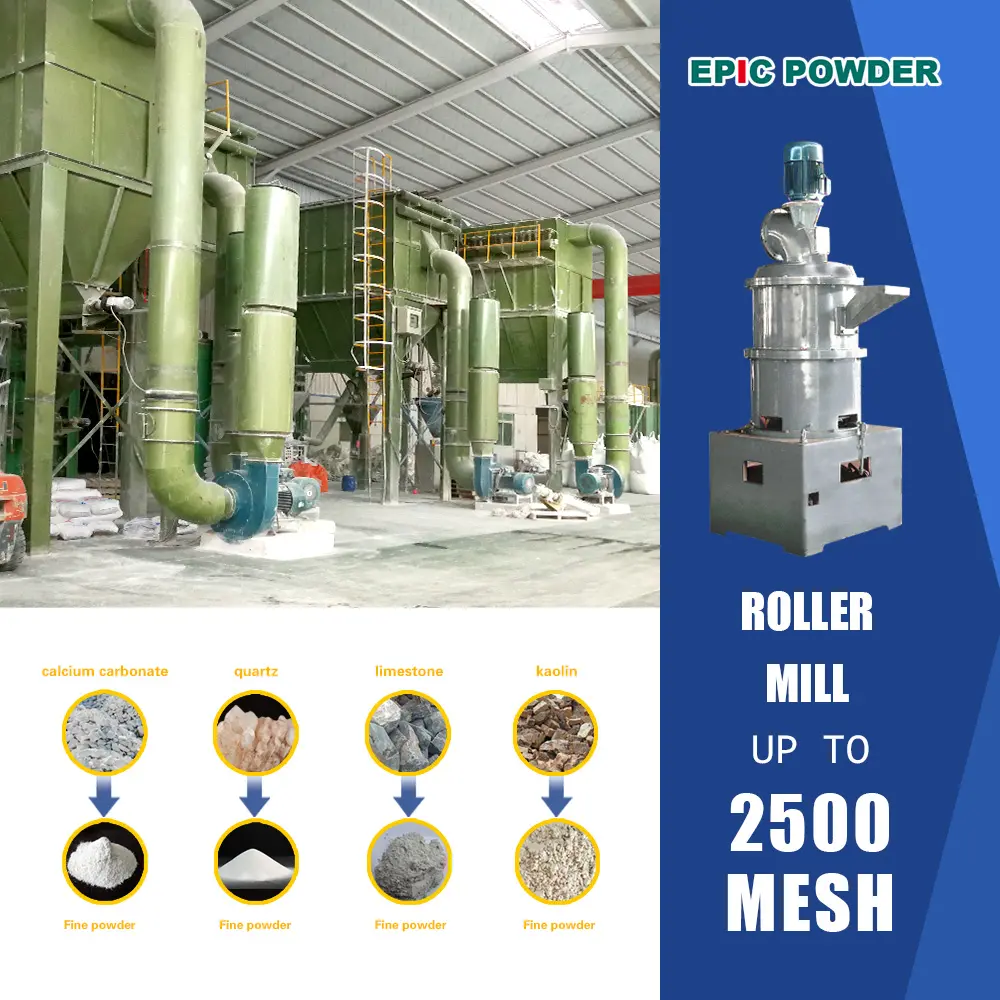
Feed material — marble crushed to below 10-20 mm — enters the mill and falls between the uppermost layer of grinding rollers and the fixed grinding ring. As the roller assembly rotates, the material is drawn into the gap where compression and shear simultaneously reduce particle size. The material cascades downward through four or more progressive grinding stages, then is carried upward by the process airflow to the integrated classifier wheel at the top of the mill.
The multi-stage grinding produces a steeper PSD curve than single-stage impact milling: particles pass through multiple grinding zones, which reduces the coarse tail without generating an excessive fines fraction. This characteristic is particularly useful for coating-grade production, where D97 and span are both specified.
The Integrated Air Classifier — The Grade-Switching Mechanism
The classifier wheel spins at a speed set by the operator via a variable frequency drive. Particles that meet the target size pass through the wheel and exit to the collection system. Oversized particles are centrifuged back to the grinding zone. The cut point — and therefore the product D97 — is a direct function of wheel speed: higher speed produces finer product, lower speed produces coarser product.
This is the mechanism that makes grade switching practical. Changing from D97 10 microns (coating grade) to D97 60 microns (filler grade) is a single parameter change — no tooling, no physical modification, no extended shutdown. The mill stabilises at the new cut point within approximately twenty to thirty minutes, after which product samples confirm the D97 is within specification and production can resume at full rate.
SRM Model Output by Grade
| Grade | D97 Target | SRM800 Output (t/h) | SRM1000 Output (t/h) | Relative Energy (vs. ball mill) |
| Coating (art/LWC) | 5-10 um | 0.5-1.5 | 1.0-3.0 | 20-30% lower |
| Medium filler | 15-30 um | 1.5-2.5 | 3.0-5.0 | 25-35% lower |
| Standard filler | 45-75 um | 2.5-4.0 | 5.0-8.0 | 30-40% lower |
Output figures are for marble with feed below 10 mm, moisture below 8%, and feed hardness Mohs 3-4. Actual performance depends on marble characteristics. Contact EPIC Powder for material-specific projections.
The energy comparison column deserves a note. Ball mills produce marble powder in the D97 10-100 micron range, but without integrated classification they produce a broad distribution. Adding an external classifier brings the total circuit energy consumption higher than the ring roller mill’s integrated design. At D97 10 microns for coating grade, the ring roller mill’s advantage is 20-30% lower specific energy — a meaningful operating cost difference over a production year.
Whiteness Retention: Why Grinding Surface Design Matters
Whiteness (ISO brightness) is the primary quality specification for paper-grade marble powder. A 1 percentage point drop in whiteness can cause a shipment to fail incoming inspection at a paper mill. The source of whiteness loss during dry grinding is almost always iron contamination from wear of the grinding surfaces.
In the SRM ring roller mill, the grinding rollers and ring are manufactured from wear-resistant alloy with a controlled iron release rate. In typical marble grinding operations, whiteness loss is kept below one percentage point across the full production run. Marble starting at 88% ISO whiteness consistently yields powder at 87% or above; marble at 92% yields powder above 91%.
For paper producers with the highest whiteness specifications — above 92% ISO — EPIC Powder offers ceramic-lined roller and ring options. Ceramic grinding surfaces (alumina or zirconia-based) introduce no iron to the product. This option is recommended when the feed marble already has high whiteness and the application demands its full preservation.
Integrated Drying: Handling Wet Marble Feed
Marble quarried in regions with high rainfall or processed by wet beneficiation often arrives at the mill with surface moisture of 5-8%. At this moisture level, standard dry mills choke — particles stick together, the feed system bridges, and classifier performance degrades.
The SRM ring roller mill handles marble feed up to approximately 8% surface moisture by drawing hot air through the grinding circuit. The drying and grinding happen simultaneously. Moisture is removed during the residence time in the mill and classifier, and the finished product typically exits at below 0.2% moisture — meeting the paper industry specification without a separate rotary dryer in most cases.
This eliminates one capital item from the plant design and removes one source of energy consumption and maintenance cost. For plants processing wet-beneficiated marble, the integrated drying capability is a meaningful practical advantage.
Technology Comparison: Ring Roller Mill vs. Ball Mill vs. Vertical Roller Mill
| Feature | SRM Ring Roller Mill | Ball Mill | Vertical Roller Mill |
| D97 range for marble | 5-75 um | 10-100 um | 10-60 um |
| Integrated classification | Yes — built in | No — external required | Yes |
| Energy at D97 10 um (relative) | Medium — 20-30% below ball mill | High baseline | Medium |
| Grade switching speed | Under 30 minutes — VFD adjustment | Slow — screen or separator change | Moderate |
| Whiteness retention | Good; ceramic option for highest grades | Moderate — ball/liner wear contributes iron | Good |
| Wet feed handling (up to 8%) | Yes — hot air drying integrated | Limited | Yes (some models) |
| Installation complexity | Low — flat pad, no steel structure | High — reinforced foundation needed | Medium |
| Planning a Marble Grinding Project for Paper Applications?EPIC Powder Machinery’s engineering team can assess your marble source, target D97 specifications, and production volume, and recommend the right SRM model with projected output and whiteness retention data for your specific raw material. We offer free material trials at our R&D facility.Tell us your marble feed size, whiteness, moisture content, target D97 (coating grade, filler grade, or both), and annual production volume. Request a Free Feasibility Study: www.rollermill.net/contact Explore Our SRM Ring Roller Mill Range: www.rollermill.net |
Frequently Asked Questions
Can the same SRM ring roller mill produce both coating-grade (D97 10 μm) and filler-grade (D97 60 μm) marble powder?
Yes — this is the SRM’s primary operational advantage for marble processors supplying multiple paper markets. The product D97 is controlled by the integrated classifier wheel speed. Increasing the speed raises the centrifugal rejection force, moving the cut point finer for coating-grade production. Reducing the speed coarsens the cut point for filler-grade production. The grade change takes under thirty minutes — set the new classifier speed, allow stabilisation, confirm D97 by sampling, and release product to the new grade stream. No physical changes to the mill are required. Typical operating practice for a multi-grade plant is to run coating-grade during the week when paper coating demand peaks, then switch to filler-grade for weekend production when coating demand drops and filler contracts need to be fulfilled. Both grades are produced at full rated output for the respective D97 target.
What whiteness can I expect from the ring roller mill when grinding marble for paper?
Whiteness loss during grinding in the SRM ring roller mill is typically below one percentage point. Marble at 88% ISO whiteness produces powder at 87% or above; marble at 92% produces powder above 91%. The wear-resistant alloy grinding surfaces are designed to minimise iron release during the compression-and-shear grinding process. For marble sources with very high whiteness (above 93% ISO) where maximum whiteness preservation is required, EPIC Powder offers ceramic-lined roller and ring sets in alumina or zirconia-based ceramic. Ceramic surfaces introduce no iron to the product and are recommended when the feed marble’s whiteness is high enough that even sub-1% loss would fall outside the paper manufacturer’s specification. The ceramic option adds cost to the initial equipment but is justified for high-value paper coating contracts with strict brightness requirements.
What is the difference between the SRM800 and SRM1000 for marble processing?
The two models differ primarily in production capacity. The SRM800 is suited to small and medium operations: it produces 0.5-1.5 tonnes per hour at coating grade (D97 5-10 microns) and 2.5-4.0 tonnes per hour at standard filler grade (D97 45-75 microns). The SRM1000 handles larger throughputs: 1.0-3.0 tonnes per hour at coating grade and 5.0-8.0 tonnes per hour at filler grade. Both models cover the same D97 range (5-75 microns), offer the same grade-switching capability, and handle the same feed size and moisture conditions. The choice between them depends on your required annual production volume and the balance between coating and filler grade production in your business. For producers supplying a single paper mill, the SRM800 is often sufficient. For producers supplying multiple customers or building stockpile inventory, the SRM1000’s higher throughput justifies the additional capital cost.
Does the ring roller mill need a separate dryer if my marble contains surface moisture?
For marble with surface moisture up to approximately 8%, no separate dryer is required. The SRM ring roller mill draws hot air through the grinding circuit, which removes surface moisture from the marble particles during grinding and classification. The finished powder typically exits at below 0.2% moisture — within the paper industry’s specification — without any additional drying step. Above 8% surface moisture, the rate of moisture introduction to the circuit exceeds the hot air’s drying capacity, and product moisture in the finished powder may exceed 0.2%. In this case, a pre-dryer upstream of the mill is recommended. The threshold moisture content depends on the marble feed rate and the available hot air temperature in your specific installation. EPIC Powder’s engineering team can confirm the drying capacity for your conditions during the feasibility study.
Epic Powder
At Epic Powder, we offer a wide range of equipment models and tailor solutions to meet your specific needs. Our team has more than 20 years experience in various powders processing. Epic Powder is specialized in fine powder processing technology for mineral industry, chemical industry, food industry, pharama industry, etc.
Contact us today for a free consultation and customized solutions!

“Thanks for reading. I hope my article helps. Please leave a comment down below.
You may also contact EPIC Powder online customer representative Zelda for any further inquiries.”
— Emily Chen, Engineer